Electric Telegraph
Sir Charles was not the 'inventor' of
the telegraph - indeed no-one can really claim that title. The
telegraph was advanced by several people starting with Stephen
Gray in 1727. However, Sir Charles was the first person with
William Cooke to develop a viable system which was made available
to the public.
  
 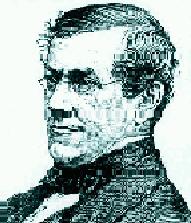  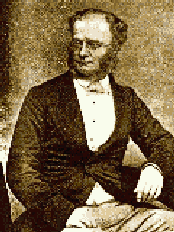
  
Sir Charles Wheatstone and Sir William Fothergill Cooke
This was first demonstrated on 24th
July 1837 when they ran a telegraph line along the railway track
from Euston to Camden Town and successfully transmitted and
received a message.
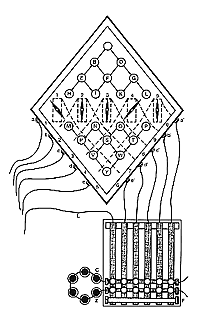 Cooke and Wheatstone's
telegraph employed five iron needles which when not in use rested
in a vertical position. Each needle could be moved either to the
left or the right by electromagnets. To transmit a letter of the
alphabet two switches were pressed which caused two needles to
move and point to the appropriate letter. By pressing different
combinations of switches any one of twenty letters could be
transmitted. Unfortunately J, C, Q, U, X and Z had to be omitted
making it difficult to send some words. Alternative methods were
adopted to spell words such as `queen', `quiz' or `axe'. Despite
its shortcomings, the advantage of their equipment was that it
could be used by unskilled operators. Cooke and Wheatstone's
telegraph employed five iron needles which when not in use rested
in a vertical position. Each needle could be moved either to the
left or the right by electromagnets. To transmit a letter of the
alphabet two switches were pressed which caused two needles to
move and point to the appropriate letter. By pressing different
combinations of switches any one of twenty letters could be
transmitted. Unfortunately J, C, Q, U, X and Z had to be omitted
making it difficult to send some words. Alternative methods were
adopted to spell words such as `queen', `quiz' or `axe'. Despite
its shortcomings, the advantage of their equipment was that it
could be used by unskilled operators.
Cooke's business acumen played a
crucial role in the success of their telegraph. He realised the
potential of an almost instant method of sending messages for the
new railway companies, and in 1837 he arranged a demonstration
between Euston and Camden stations, a distance of 1.5 miles
(2.4km).
There were problems in insulating the
iron wires which carried the signal. The wires were covered with
cotton and buried in iron pipes beside the railway line. While
the wires remained dry there was no problem but if they became
wet the insulation failed. Nevertheless, the equipment clearly
impressed the Directors of the Great Western Railway who allowed
a trial to take place between Paddington and West Drayton. The
trial was a partial success. The company did not accede to
Cooke's request to extend it to Bristol, but did agree an
extension as far as Slough, provided railway messages were
carried free of charge. Cooke overcame the insulation problems by
suspending the wires from iron posts using glass insulators. This
extension was paid for by Cooke and Wheatstone and to recover
some of the expense they offered the public the opportunity to
send messages at a shilling (5p) a time.

Advertisement for a
telegraph demonstration, 1839.
Although the five needle telegraph
was easy to operate it required six wires. It was soon replaced
by a single needle instrument. Each letter of the alphabet was
given a code of right and left needle movements, and in this way
messages could be transmitted. However, this required skilled
operators.
In 1844 the first public telegraph
line opened along the railway line between London and Gosport. It
provided the Admiralty with a direct link to the naval base at
Portsmouth.
Slowly, the advantages and potential
of the electric telegraph were being realised. However, it was
the use of Cooke and Wheatstone's telegraph to apprehend a
criminal that caught the public imagination.
The Cords that Hung John Tawell
On New Year's Day 1845 John Tawell
travelled by train to Slough with one purpose in mind to murder
his mistress. They met and he emptied the contents of a phial of
poison into her drink. Rather naively he expected that when she
finished her drink she would expire conveniently at his feet.
Instead his victim let out a bloodcurdling scream and in his
panic he ran out into the street to make his escape.
Neighbours also heard the scream and,
opening their doors to find out what the commotion was about, saw
him hurrying up the road looking very agitated. Tawell made his
way to the station where a train was about to depart for London.
Settling back in his seat, as the train sped along the tracks, he
was convinced he had escaped and that once in London he could
disappear in the crowds.
Meanwhile, the murder had been
discovered and news soon reached the station of the man who had
aroused suspicion. As he sat in the train he could not have known
that travelling along the wires beside the speeding train flashed
a message which would arrive in London long before he did.
The message read:
There was some confusion at
Paddington about the word `KWAKER'. The telegraphist thought it
was an error but after it was transmitted a third time he
realised that it represented the word `QUAKER', the five needle
telegraph being unable to transmit the letters `Q' or `U'.
Immediately the police were summoned
and were at the station when the train pulled in.
Tawell walked out of the station,
quite unaware that he was being watched, and caught an omnibus.
The conductor who collected his fare was a policeman in plain
clothes who also followed Tawell when he left the bus. At his
lodgings the constable confronted him and asked if he had just
come from Slough. Tawell answered `no' and was promptly arrested.
He was later tried, found guilty of murder and hanged.
The American Dimension
Cooke and Wheatstone are generally
credited as having developed the first working electric
telegraph, but at almost the same time Samuel Morse, working in
America, was developing his own. At first he concentrated on
designing a machine which could record the incoming message on a
moving paper tape, but he simplified his equipment so that the
receiver made only a sound. He also devised a code which still
bears his name. Morse's telegraph and code were soon adopted
throughout the world and it is his name that is most associated
with the electric telegraph.
For further information of the
Electric Telgraph and History of Communication visit the superb
Cable & Wireless Site from where the majority of the above
information has been taken.

|
