|
the Holocaust


This
is a picture of Emanuel and Avram Rosenthal, who died at Majdanek
The
Nazis were cruel. The Nazi Regime did terrible things. These
things need to be remembered to ensure that they are never
repeated. The people who died in WWII, in all wars, were people.
They were living, breathing, loving, hoping, dreaming, thinking
people. A number is overwhelming and it is sometimes difficult to
remember that all those numbers had mothers and sons and loves
and dreams and faces and memories and everything. Six million is
the estimated number of people who died in the holocaust.
Many
people died or suffered as a result of Nazi Euthanasia
(the
link above goes to a page that i did not write, but i think it is
very informative) The prisoners in the camps wore various badges to identify their "crime."
take a look at some of these badges.
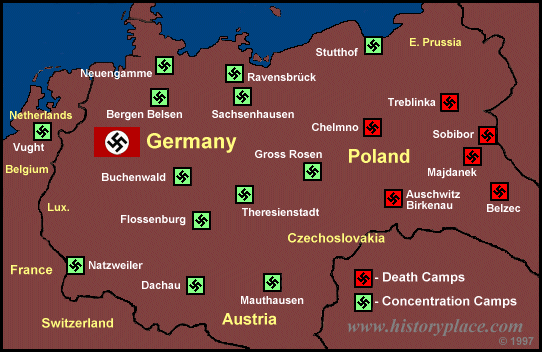
Concentration
camps- the vast hutted camps for
prisoners of the Third Reich used as prisons, as slave labor
reservoirs and as killing sites. The Nazi Party Boxheim Papers,
uncovered in a scandal of 1931, had foretold the creation of
special camps to hold enemies of the state. As soon as Hitler
took power in Germany in January 1933, SA men, acting as
'auxiliary police', began rounding up all possible enemies and
putting them under guard in hurriedly constructed camps, first at
Esterwegen and Dachau and soon at othe sites. Many of these SA
'wild camps' were closed down after the first enthusiasm for
arrests, and reorganization on the pattern of Eicke's Dachau
administration followed. The first detainees were those accused
of membership of KDP (Communist Party of Germany)
or SDP (Socialist
Party of Germany) or their auxiliary organizations, freemasons,
and Jehovah's Witnesses. They were soon joined by thousands
accused of associating with Jews-or indeed anyone regarded as
'undesirable' by Nazi officials.
The camps were at
first officially described as 're-education' camps, but the SS
soon adopted the term 'concentration' camps, the name taken from
camps set up by the British during the Boer War (1899-1902) to
'concentrate' Boer farming families during war operations. At
this period the three main camps under Eicke's Concentration Camp
Directorate were Dachau, Buchenwald, and Sachsenhausen. By now
every type of opponent of the regime was subject to Schutzhaft
(protective custody): Jews, trade unionists and communists were
followed by gypsies, homosexuals, petty criminals, Protestants,
Catholics, and dissenters of all kinds. It was, not surprisingly,
a period when many old scores were settled. Camp inmates were
regimented and wore serial numbers and colored patches to
identify their categories: red for politicals, blue for the
stateless or those who had tried to escape from the Third Reich,
violet for religious fundamentalists, green for criminals, black
for those declared anti-social, and pink for homosexuals.
The regular camps
(which rapidly came to include Belsen and Gross-Rosen in Germany,
Mauthausen in Austria and Theresienstadt in Czechoslovakia) were
commanded by an SS officer of the rank of colonel or major and
divided into military-style companies with a captain or
lieutenant in effective control of the prisoners. Each camp block
was under the charge of a senior prisoner. The original mix of
political and criminal elements was expected to make the latter
harass the former, but in time the politicals proved more
reliable prisoners and were given most of the posts of
responsibility. After 1939, as more camps opened, staffing needs
were often filled by Baltic or Ukranian Germans who, having
themselves suffered as members of depressed communities, were now
willing to persecute Russians, Poles, and Jews.
The SS-WVHA
(wirtschaftsverwaltungshauptampt)[business enterprises],
responsible for the
commercial and industrial interests of the SS, took over the
administration of the camps from the beginning of 1942; new camps
were set up to be associated with the new war munition factories
being built away from old sites to avoid air attack. The growth
of SS-WVHA industries led to competition in the SS between the
extermination and the cheap-labor schools of thought, and both
styles of camps survived to the end of the war. The system grew
as the industry grew, main camps having their satellite camps,
often built by the industries themselves, for the supply of
labor. In August 1941 there were 10 main camps with 25
satellites; in April 1942, 15 with 10; by April 1944 the total
had risen to 20 main camps with 65 sub camps; and by the end of
1944 there were 13 parent camps (the number having been reduced
by Russian advances in the east) with about 500 sub camps. The SS
charged industrial companies four to eight marks per day for the
use of prisoners working a full twelve hour day. The average
survival of a prisoner in a work camp was nine months, and in
this ime the SS could count on a net gain of 1,431 marks from
each laborer.
Following the
Wannsee conference which in January 1942 sought to make the
extermination of the Jews a systematically organized operation,
extermination camps were founded in the East. Belzec opened in
March with a planned killing capacity of 15,000 a day, Sobibor in
April handled its full 20,000 deaths per day by May, followed by
Treblinka, where most Warsaw Jews were taken, and Majdanek, both
with a 25,000-per-day capacity. The capacity of Auschwitz was
increased seven times between 1942 and 1944. Other camps, like
Bergen-Belsen and Natzweiler, caused death by neglect. Recent
research suggests that, between 1933 and 1945, a total of
1,600,000 people were sent to concentration work camps, of whom
over one million died. The extermination camps are estimated by
some historians to have taken in 18 million, killing as many as
11 million. But it is important to emphasize that this is one
area of the Third Reich where accurate figures are impossible to
obtain. A figure of close to six million seems most likely.
Women were first
detained in ordinary prisons but, as the numbers grew, a special
camp was opened , in October 1933, at Moringen in Bavaria. A
poor-house director was placed in charge and guards were
recruited from the Nazi Women's Front. In March 1938 men were
moved out of Lichtenberg in Saxony and it was converted into a
women's camp. But the major women's camp was Ravensbruck in
Mecklenburg, surrounded by forest and lake, and opened in May
1939 with 867 prisoners. By October 1944 the number had grown to
42,000 from twenty-three nations; in all about 133,000 women were
sent to Ravensbruck and 92,700 died there.
After the war many
Germans claimed ignorance of the camps' existence, but certainly,
outside Germany , evidence abounded. The British government
published a White Paper on them in 1939 and a widely read Penguin
book on international affairs (1939) listed Buchenwald, Dachau,
Oranienburg, and Papenburg. Reluctance outside Germany to believe
horror stories was probably due to British allegations of German
atrocities during the 1914-18 war which were later proved to be
untrue. Karl Wolff, Himmler's SS Chief of Staff, however claimed
that Himmler had never spoken to him about extermination camps.
Most seem to have imagined that the camps simply provided labor
for delinquents, and to have closed their minds to accounts of
brutality.
The principle camps,
most of which had numbers of satellite work camps, often
associated with particular factories, were:
Esterwegen
(opened
March 1933)- The earliest major camp. Converted to a special
punishment camp, it was at first run by the Ministry of Justice.
Dachau (March 1933).
The camp whose administration under Eicke became a model for all
other camps. Its deceptive slogan over the gate read "Arbeit
Macht Frei" (Work brings freedom). At the end of WWII it was
used to house the 'Prominenten', the prisoners Himmler hoped
might be used for some sort of bargaining.
Oranienburg (1933)
became a satellite of Sachsenhausen.
Buchenwald (1933)-In
1945 there were 47,500 detainees from thirty countries.
Gross-Rosen (1934)-
A Silesian camp.
Sachsenhausen
(1934)- uesd as the Gestapo interrogation center when its Berlin
center, Columbia House, became overcrowded in 1936. Over 100,000
deaths took place in this camp and its satellites.
Mauthausen (1938-9)-
near Linz, Austria
Flossenburg (1938)-
where many Gestapo prisoners were taken as the war ended and were
hanged or shot.
Theresienstadt
(1939)-At first it was advertised as a special ghetto home for
Jews, and international visitors were persuaded of this. It was
later converted to an extermination camp.
Ravensbruck (opened
in 1939)- for women. Fifty miles north of Berlin where the
specialist industry was a clothing factory, re-modelling furs.
Neuengamme (1940)-
near Hamburg
Auschwitz (1940)-
The most infamous of all camps where the commandant Hoss,
developed his mass extermination techniques. Possible 1,500,000
victims.
Natzweiler (1941)-
where prisoners were worked in the quarries.
Birkenau (1941)-
ordered by Himmler specifically as a killing center for Russian
officers.
Chelmno (1941)- the
first extermination camp
Belzec (1942)-
600,000 deaths.
Sobibor
(1942)-extermination camp claiming 250,000 victims.
Treblinka (1942)-
where 700,000 people died.
Lublin-Majdanek
(1942)-site of 200,000 murders
Bergen-Belsen- where
some 50,000 died from disease and starvation.
By early 1945 the
Final Solution was grinding to a halt and SS local headquarters
were making the last hopeless attempts to destroy the abundant
evidence of their guilt. It was of course impossible, because the
evidence consisted not only of charred bones and mountains of
unclaimed shoes and clothing but also in the silence of the once
Jewish Polish and Russian villages and in the absence of Jewish
voices throughout much of post-war Europe. this information was taken from The Penguin Dictionary of the Thrid Reich by James Taylor and Warren Shaw.
back to main page
|