“A long habit of not thinking a thing wrong, gives it a superficial
appearance of being right,” argued Thomas Paine.
But let common sense have its day in the fertile ground of free speech, let
every man have access to the Holy Writ and freedom of religion, so that he might
read and consider what generations past have not been permitted to read and
consider, and the tide will turn.
In America it did. One of the monumental tide turners was Thomas Paine. His
weapons were reason, revelation, and an extraordinary literary gift.
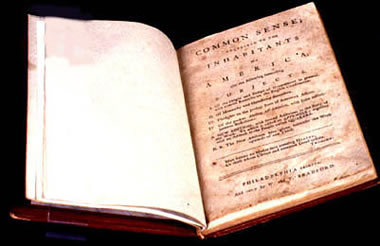
In January of 1776, Thomas Paine put that gift to work when he published a
booklet filled with what George Washington called, “unanswerable reasoning”; and
what others argued were just the right words to stroke the common man´s heart,
and inflame the common man´s nobler passions to believe in, and fight for
independence. The booklet´s name was “Common Sense.” In a day when the
population was under 3 million, it reportedly sold 1.5 million copies. Other
than the Holy Bible, “Common Sense” was America´s first bestseller.
Just as importantly, the book and its arguments were blatantly Christian.
His stand against monarchy, in this day and age of secularism, is something
to behold.
“‘Tis a form of government which the word of God bears testimony against”, he
writes. And then he gives the how and why as to why this was so, in what could
have easily passed for a Sabbath Day sermon.
“In the early ages of the world, according to the scripture chronology, there
were no kings; the consequence of which was there were no wars; it is the pride
of kings which throw mankind into confusion. Holland without a king hath enjoyed
more peace for this last century than any of the monarchical governments in
Europe. Antiquity favors the same remark; for the quiet and rural lives of the
first patriarchs hath a happy something in them, which vanishes away when we
come to the history of Jewish royalty.
“Government by kings was first introduced into the world by the Heathens,
from whom the children of Israel copied the custom. It was the most prosperous
invention the Devil ever set on foot for the promotion of idolatry. The Heathens
paid divine honors to their deceased kings, and the Christian world hath
improved on the plan by doing the same to their living ones. How impious is the
title of sacred majesty applied to a worm, who in the midst of his splendor is
crumbling into dust!
“As the exalting one man so greatly above the rest cannot be justified on the
equal rights of nature, so neither can it be defended on the authority of
scripture; for the will of the Almighty, as declared by Gideon and the prophet
Samuel, expressly disapproves of government by kings. All anti-monarchical parts
of scripture have been very smoothly glossed over in monarchical governments,
but they undoubtedly merit the attention of countries which have their
governments yet to form. Render unto Cesar the things which are Cesar´s, is the
scripture doctrine of courts, yet it is no support of monarchical government,
for the Jews at that time were without a king, and in a state of vassalage to
the Romans.
“Near three thousand years passed away from the Mosaic account of the
creation, till the Jews under a national delusion requested a king. Till then
their form of government (except in extraordinary cases, where the Almighty
interposed) was a kind of republic administered by a judge and the elders of the
tribes. Kings they had none, and it was held sinful to acknowledge any being
under that title but the Lord of Hosts. And when a man seriously reflects on the
idolatrous homage which is paid to the persons of Kings, he need not wonder,
that the Almighty ever jealous of his honor, should disapprove of a form of
government which so impiously invades the prerogative of heaven.
“Monarchy is ranked in scripture as one of the sins of the Jews, for which a
curse in reserve is denounced against them. The history of that transaction is
worth attending to.
“The children of Israel being oppressed by the Midianites, Gideon marched
against them with a small army, and victory, thro' the divine interposition,
decided in his favour. The Jews elated with success, and attributing it to the
generalship of Gideon, proposed making him a king, saying, Rule thou over us,
thou and thy son and thy son´s son. Here was temptation in its fullest extent;
not a kingdom only, but an hereditary one, but Gideon in the piety of his soul
replied, I will not rule over you, neither shall my son rule over you. THE LORD
SHALL RULE OVER YOU. Words need not be more explicit; Gideon doth not DECLINE
the honor, but denieth their right to give it; neither doth he compliment them
with invented declarations of his thanks, but in the positive stile of a prophet
charges them with disaffection to their proper Sovereign, the King of heaven.
“About one hundred and thirty years after this, they fell again into the same
error. The hankering which the Jews had for the idolatrous customs of the
Heathens, is something exceedingly unaccountable; but so it was, that laying
hold of the misconduct of Samuel's two sons, who were entrusted with some
secular concerns, they came in an abrupt and clamorous manner to Samuel, saying,
Behold thou art old, and thy sons walk not in thy ways, now make us a king to
judge us like all the other nations.
“And here we cannot but observe that their motives were bad, viz. that they
might be like unto other nations, i.e. the Heathens, whereas their true glory
laid in being as much unlike them as possible. But the thing displeased Samuel
when they said, give us a king to judge us; and Samuel prayed unto the Lord, and
the Lord said unto Samuel, hearken unto the voice of the people in all that they
say unto thee, for they have not rejected thee, but they have rejected me, THAT
I SHOULD RULE OVER THEM. According to all the works which they have done since
the day that I brought them up out of Egypt even unto this day, wherewith they
have forsaken me, and served other Gods: so do they also unto thee. Now
therefore hearken unto their voice, howbeit, protest solemnly unto them and show
them the manner of kings that shall reign over them, i.e. not of any particular
king, but the general manner of the kings of the earth, whom Israel was so
eagerly copying after. And notwithstanding the great distance of time and
difference of manners, the character is still in fashion.
“And Samuel told all the words of the Lord unto the people, that asked of him
a king. and he said, this shall be the manner of the king that shall reign over
you; he will take your sons and appoint them for himself, for his chariots, and
to be his horseman, and some shall run before his chariots (this description
agrees with the present mode of impressing men) and he will appoint him captains
over thousands and captains over fifties, and will set them to ear his ground
and reap his harvest, and to make his instruments of war, and instruments of his
chariots; and he will take your daughters to be confectionaries, and to be cooks
and to be bakers (this describes the expense and luxury as well as the
oppression of kings) and he will take your fields and your olive yards, even the
best of them, and give them to his servants; and he will take the tenth of your
seed, and of your vineyards, and give them to his officers and to his servants
(by which we see that bribery, corruption, and favouritism are the standing
vices of kings) and he will take the tenth of your men servants, and your maid
servants, and your goodliest young men and your asses, and put them to his work;
and he will take the tenth of your sheep, and ye shall be his servants, and ye
shall cry out in that day because of your king which ye shall have chosen, AND
THE LORD WILL NOT HEAR YOU IN THAT DAY. This accounts for the continuation of
monarchy; neither do the characters of the few good kings which have lived
since, either sanctify the title, or blot out the sinfulness of the origin; the
high encomium given of David takes no notice of him officially as a king, but
only as a man after God's own heart.
“Nevertheless the people refused to obey the voice of Samuel, and they said,
nay, but we will have a king over us, that we may be like all the nations, and
that our king may judge us, and go out before us, and fight our battles. Samuel
continued to reason with them, but to no purpose; he set before them their
ingratitude, but all would not avail; and seeing them fully bent on their folly,
he cried out, I will call unto the Lord, and he shall send thunder and rain
(which then was a punishment, being in the time of wheat harvest) that ye may
perceive and see that your wickedness is great which ye have done in the sight
of the Lord, IN ASKING YOU A KING. So Samuel called unto the Lord, and the Lord
sent thunder and rain that day, and all the people greatly feared the Lord and
Samuel. And all the people said unto Samuel, pray for thy servants unto the Lord
thy god that we die not, for WE HAVE ADDED UNTO OUR SINS THIS EVIL, TO ASK A
KING.
“These portions of scripture are direct and positive. They admit of no
equivocal construction. That the Almighty hath here entered his protest against
monarchical government, is true, or the scripture is false. And a man hath good
reason to believe that there is as much of kingcraft, as priestcraft, in
withholding the scripture from the public in [certain European] countries.”
No wonder then, Paine goes on to proclaim what rang in every American heart in
his day:
“But where some say is the king of America? I´ll tell you Friend, he reigns
above, and doth not make havoc of mankind like the royal brute of Great Britain.
Yet that we may not appear to be defective even in earthly honors, let a day be
solemnly set apart for proclaiming the charter; let it be brought forth placed
on the divine law, the Word of God; let a crown be placed thereon, by which the
world may know, that so far as we approve of monarchy, that in America the law
is king. For as in absolute governments the king is law, so in free countries
the law ought to be King; and there ought to be no other.”
Who is the King of America? Paine answers, “God.” And what is his
Constitution? “[T]he divine law, the Word of God.”
In this day and age when Christians are being told to be silent, when
monuments honoring the Ten Commandments are being hauled out of public buildings
by officers of the law, and Christians are being hauled off to jail for
protesting their removal; it seems like it is time for Christians to learn to be
more effective, more assertive, and more persuasive in revealing the true source
of our laws and our liberties.
Pulling out a copy of Thomas Paine´s “Common Sense,” to read, and share, and
put back in the classroom, might just be a good place to start.
What a revelation for our neighbors, and our children´s schoolteachers to
find out that the Biblical revelation to have “no other God´s before me”
motivated the Founders of our nation to throw off monarchy and other tyrannical
forms of government.
Bibliography
Paine, Thomas. “Common Sense.” Emphasis in the original.
Author´s note
A tribute to Paine´s character, though a man of diminutive means, he never
accepted so much as a penny for his writing of “Common Sense,” but donated all
the profits to the revolution, a tradition he never departed from in all his
book publishing.