Ammunition
Ammunition Types
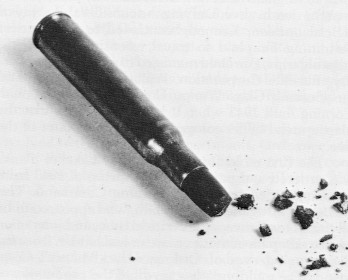
Left, one more unusual type of ammunition was this T-44 .30
frangible round. The projectiles were made from a mixture
of lead and bakelite, and trainee gunners fired them at
specially armored Bell RP-63 Kingcobras. Despite the RP-63's
armor, muzzle velocity had to be kept down to 415m/sec, and
the recoil-operated Browning .30 M2 guns needed some gas
assistance to function. Gunsights and aircraft speeds were
chosen to give trainees the correct "feeling" of the .50 that
was the standard USAAF armament of the time.
[27]
The following types of ammunition are common for anti-aircraft use:
AP. Armour-piercing rounds may be
simple, solid projectiles. More often they have a sleeve of soft, light
metal wrapped around a hard core, for example hardened steel or
tungsten. The hard core is the penetrator. The sleeve is kept light to
reduce the total weight of the round, so that the projectile is given a
higher velocity. Its softness reduces the probability that the
projectile will glance off armour. And in small-calibre weapons, it also
grips the rifling of the barrel. Post-WWII developments such as
discarding-sabot AP ammunition (APDS) are not commonly used against
aircraft, but may be carried for use against ground targets.
HE. High Explosive rounds were
traditionally made by boring out the core of a solid projectile, then
filling it with explosive. The German Minengeschoß rounds introduced a different
manufacturing technique: A thin shell was drawn, in the same way as a
cartridge case is drawn. This resulted in a much larger explosive
capacity for the same calibre, and became widespread after the war. It
is commonly assumed that HE ammunition is really effective only in calibres
of 20mm or larger, but it was also made for 12.7mm and even
rifle-calibre weapons.
I. Incendiary rounds were first
developed in small calibres during WWI. The bullet was filled with
incendiary rather than explosive material. Early on, the material was
often phosphorus, ignited by the actual firing of the round. Later
fused projectiles, which ignited only when hitting the target, also
appeared. Pure incendiary ammunition was often replaced by
high-explosive ammunition with an incendiary compound mixed in, HE/I.
SAP/I or SAP/HE. Semi-Armour Piercing rounds are similar
to the traditional designs for HE and I rounds, but the hollow outer
shell is stronger and made of hardened material, so that some
armour-penetrating capacity is retained. Optimists may call such
ammunition AP/I or AP/HE. Modern fillings can combine both effects,
so that SAPHEI ammunition is created.
Tracer rounds have some material in the
base of the projectile, which burns during flight and indicates the
trajectory. For use at night "glowing" ammunition, which gives a fainter
light, was developed. The disadvantage, especially in rifle-calibre
ammunition, is that the tracer rounds have a different trajectory from
the rest. In addition, the high visibility of tracer alerts the target,
but it may also have a deterrent effect.
Self-destruct systems can be simple
chemical systems, which take a preset time to burn, or intricate
mechanical fuses. They are designed to avoid "collateral" damage, and
may also be used for training.
Ammunition had to be fed into a gun, and it had to be stored in the
aircraft. The two main alternatives are the drum and the belt
(clips are hardly an option for aircraft guns). The drum is the simplest
solution: It contains loose rounds, which are often fed into the gun by
means of a circular spring. However, drums often have inconvenient
shapes for installation in aircraft, they are bulky, and they contain a
fixed, often small number of rounds. A much better solution was to link
the rounds together to a belt, that could be stored in a box or tray
with a convenient shape. Often the belt is of disintegrating type: After
removal of the rounds, it falls apart in links which can be stored or
dumped overboard. The belt can be made as long as the feeding mechanism
can pull. However, the design of a belt feed mechanism is more
complicated than that of a drum, and suitable feed mechanisms took a
long time to perfect. Therefore most cannon had drums at the time of
their first application, but at the end of the war almost everyone had
switched to belts.
Ammunition Belt Composition for German Fighters
These are the belt compositions for fighters, used against air
targets, as given given in a German manual, published in in 1944. (Ref.
204.) Note that these were more or less
advisory: Local commanders were encouraged to determine the armament mix
that suited them.
7.92 mm (MG 17)
- 5 SmK-v
- 4 PmK-v
- 1 B-Patrone-v
SmK ammunition was AP with a hard steel core and a lead
sleeve. The probable explanation of the acronym is Spitzgeschoss mit
Kern, pointed ball with core. PmK also had a steel core, but
the core was surrounded by phosphorus, which ignited when the round was
fired. Finally B-Geschoß was a Beobachtungs or
observation round: It had a small HE charge and some incendiary
material, and exploded on contact with the target. In this way the pilot
was able to verify that he was hitting the target. During the Battle of
Britain, the British used the Dixon-De Wilde round for similar
purposes, and pilots generally felt that this was extremely useful.
13 mm (MG 131)
- 1 Panzergranatpatrone L'spur o. Zerl
- 2 Brandsprenggranatpatronen L'spur o. Zerl
The 13mm Panzergranatpatrone was a solid AP round. The
Brandsprenggranatpatrone was a conventional HE/I round, a
bored-out projectile filled with an explosive mixture. German armourers
were warned that the first round fired had to be an AP round: The cap
over the muzzle had to be destroyed first, and there was the possibility
that the HE/I round would go off when it hit this. Note that for both
rounds, tracer was chosen (L'spur, or Leuchtspur) but that there
was no selfdestruction (o. Zerl, or ohne Zerlegerung).
15 mm (MG 151)
- 4 Brandsprenggranatpatronen L'spur m. Zerl
- 1 Panzergranatpatrone L'spur o. Zerl
Rather similar to the 13mm, except that the HE/I rounds now do have
self-destruction mechanisms. It was common to use a combined
self-destruction fuse and tracer: The projectile exploded when the
tracer was burnt out. On some projectiles, special self-destruction
fuses were used. They were set to 3 seconds, except before April 1941
when they were set to 1.7 seconds.
The MG 151 was a high-velocity weapon, and for ground attack missions
Hartkernmunition, AP with a tungsten core, was loaded.
20 mm (MG-FF, MG 151/20)
- 2 Minengeschoß m. Zerl.
- 2 Brandsprenggranatpatronen L'spur m. Zerl
oder Brandgranatpatronen
- 1 Panzersprenggranatpatrone o. Zerl
oder Panzerbrandgranatpatrone (Phospor) o. Zerl.
Here the Minengeschoß appears for the first time. A
version of the 20mm M-Geschoß with tracer did not exist, so tracer
was used on HE/I (Brandsprenggranatpatrone) or pure incendiary
(Brandgranatpatrone) rounds. The latter was apparently a new
development in 1944, intended to replace the less effective HE/I. The
fifth round was a semi-AP projectile, explosive or incendiary.
Apparently the main reason this was used instead of a solid AP
round was that a solid projectile would have been too heavy.
It was recommended that more AP or semi-AP ammunition would be
loaded when the probable targets were well-armoured attack aircraft such
as the Il-2. On the other hand, against the four-engined bombers of the
RAF and USAAF the high explosive types were more effective.
30 mm low-velocity (MK 108)
- Minengeschoß 108 El o. Zerl.
Only the Minengeschoß was fired by the MK 108, also in
versions with day or night tracer. The ammunition was not interchangeable
with that of the much more powerful MK 101 and MK 103, hence the
addition 108. The letters El probably indicate the presence of
Elektron, an incendiary compound, in the projectiles.
Surprisingly, self-destruction fuses were not used, although German
fighters were operating over the home country at this time in the war.
Probably it was felt that this reduced the effective range too much.
30 mm high-velocity (MK 101, MK 103)
- 1 Sprenggranatpatrone L'Spur o. Zerl
- 1 Minengeschoß L'Spur o. Zerl
- 1 Panzersprenggranatpatrone L'Spur o. Zerl
oder Panzerbrandsprenggranatpatrone L'Spur o. Zerl
The MK 103 was a high-velocity weapon with a much better armour
penetration than the MK 108. Hence the addition of the older type of HE
round and semi-AP ammunition to the mix. The exception were the
nightfighters, which used only the Minengeschoß with a
glowing trace (Gl'spur).
For anti-tank missions, Hartkernmunition with tungsten cores was
used, but it would be wasteful to use this scarce ammunition against
aircraft.
Ammunition Belt Composition for Bombers
For bomber defensive guns of 7.92mm and 13mm calibre, the following
combinations were recommended:
7.92 mm (MG 15, MG 17, MG 81)
- 2 SmK
- 2 SmK L'spur
oder SmK Gl'spur
- 2 PmK
- 2 SmK
- 2 SmK L'spur
oder SmK Gl'spur
- 1 PmK
- 1 B-Geschoß
The main difference with the ammunitions mix for fighters is in the
use of tracer, avoided for fighters except to mark the end of the belt.
On the other hand, only one in twelve rounds is the
B-Geschoß.
13 mm (MG 131)
- 1 Panzergranatpatrone L'spur o. Zerl
- 1 Brandsprenggranatpatrone o. Zerl
- 1 Sprenggranatpatrone L'Spur Üb m. Zerl
This load is a mixture of AP and HE/I with training ammunition
(Übung) with self-destruct fuses! This was used in the MG
131 because it detonated after about 700m, and the flashes had a
deterrent effect on attacking fighters. The relatively generous use of
tracer and phosphorus ammunition in the MG 17 probably had a similar
background.
Next: WWII Fighters
© 1998-1999
Emmanuel Gustin
gustin@uia.ua.ac.be
visitors since 23 December 1998.
This page hosted by 
Get your own Free Home Page
|
