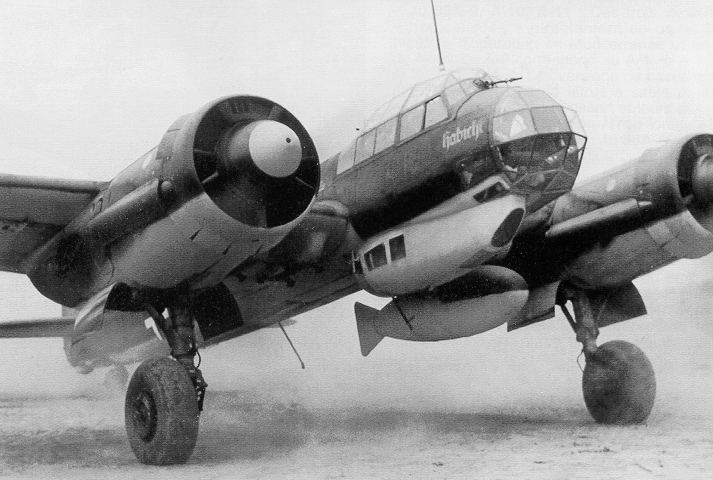
Defensive Armament
Although the subject of these pages is a different one, it would be
an omission not to discuss the defensive, flexible, armament of
multi-seat aircraft. The evolution of flexible armament was different
from that of fixed armament, mainly because the gun mounts imposed more
constraints on the guns that could be used. Smaller weapons survived in
defensive positions after they became obsolete as fighter armament.
Open Positions
The first aircraft used by military services were a mixture of
monoplanes and biplanes. After the first months of the First World
War the biplane became prominent. The original lay-out for two-seaters
placed the observer in the front seat, between the center section of the
wings, and the pilot behind him. The result was a poor field of view and
of fire for the observer, so in the second generation of military
aircraft the observer was moved to the rear seat. This made it possible
for him to defend the rear sector with a flexible machinegun, typically
a drum-fed rifle-calibre weapon.
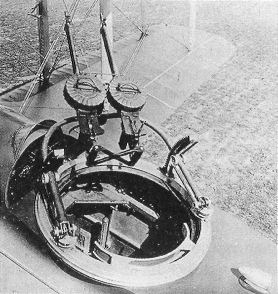
Twin Lewis guns as the rear defense of a de Havilland D.H.4
bomber. They are trained far forward; probably it would not
be advisable to fire in that direction!
[39]
Accurate fire required a steady gun mount, that would allow the gun
to be pointed at the target in such way that the gunner could always
look over the sight. A simple pintle mount did not meet that
requirement. The most common solution was to fix the machinegun on a
ring fixed over the rim of the cockpit, so that it could be aimed in all
directions. The best known solution is the Scarff ring, named after its British
inventor.
Multi-engined bombers could carry more than one gunner, but the
choice of the gun positions presented a problem in itself. Some bombers
had long, rectangular fuselages, which allowed for gun positions in the
extreme nose and the extreme tail. The Germans also devised the "tunnel
gun", a gun which fired rearwards and downwards through a "tunnel" in
the bottom of the aft fuselage. This protected the bomber against
attacks from below. Innovative designers did not hesitate to put gunners
on top of the wing, or in the aft ends of the engine nacelles.
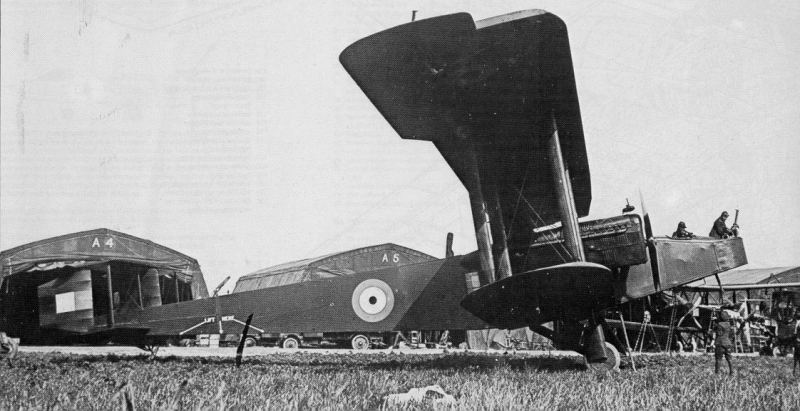
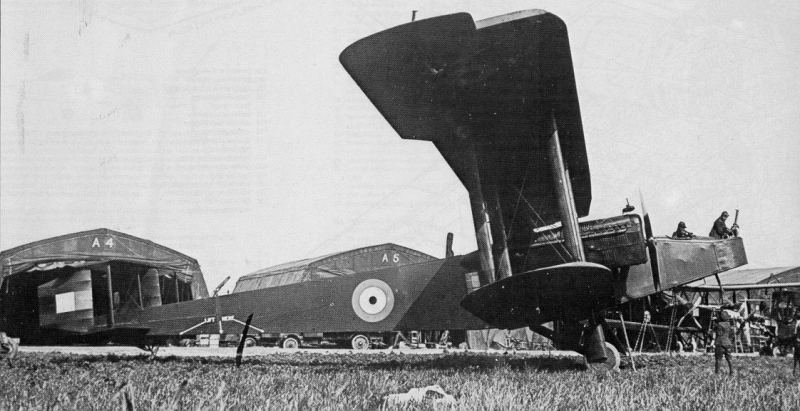
Handley Page O/100 bomber. There was a gunner in the tip of the
nose and one in the fuselage, aft of the wing trailing edge. The
nose gunner had a wide field of fire, but his position was rather
uncomfortable.
[69]
An important day for strategic bomber operations was 13 June 1917,
when daylight bombardments on London began with an attack by 20 Gotha G.IV bombers. During the very first
attacks the defence was poorly organized and ineffective. But already on
22 August the Germans suspended daylight attacks because of the high
attrition suffered by KG 3. After that date, the large bombers would
operate only at night.
The vulnerability of bombers to fighter attack resulted, already
during WWI, in the creation of specialized day and night bombers. Only
the faster, nimbler aircraft, often single-engined, could operate safely
during the day. Less performant aircraft had to seek the protection of
the night. These included large multi-engined aircraft capable of
carrying a heavy bomb load, but also various obsolescent light bombers
or even obsolete fighters. For example, the British retaliation for the
German attacks on London consisted of attacks using the de Havilland DH.4 at day, and the Royal Aircraft Factory FE.2B and Handley-Page
0/100 at night.
The first turrets
The disadvantages of open gunnery positions are many. The gunners
were exposed to the elements at low altitudes, or to the cold and thin
air at high altitudes. The drag was considerable. The slow bombers of
the First World War did not create a strong enough airflow to interfere
with aiming, but on faster biplane bombers, such as the Hawker Hart and its fighter development the Demon, this began to be a problem. The
installation of windscreens to deflect the airflow was at best a partial
solution. And one or two rifle-calibre machineguns turned out to be all
that a gunner could handle, although the Germans did experiment with the
20mm Becker cannon during WWI.
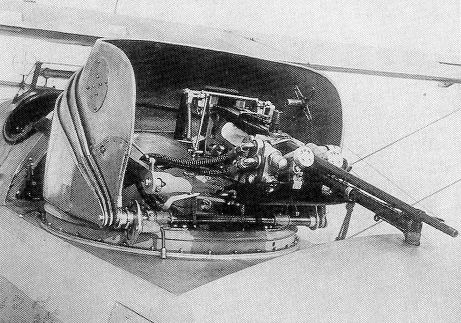
The Hawker Demon was a fighter development of the Hart
bomber. The prototype was fitted with this "lobster shell"
turret, designed by Frazer-Nash. But its weight and the
disturbed airflow around it prevented its adoption as
standard.
[70]
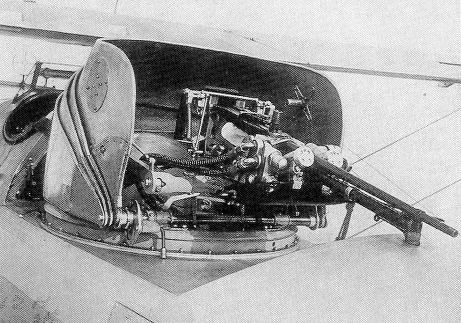
The solution was the enclosed gun turret, initially manually
operated, but soon using external power to drive the traverse. A
well-designed turret provided a stable gun mount, and allowed the use of
heavier armament and better gunsights. Because there needed to be
openings in the turret for the guns, the gunner's position remained cold
and draughty, but it was better than being completely exposed. On the
negative side, many turrets were so cramped that they did not allow the
gunner to wear a parachute, and were difficult to leave in an emergency.
Heavy framing often restricted the view of the gunner.
A well-designed turret would not have too much drag, but many were
bulky and heavy, and the aircraft that carried them often suffered a
significant performance penalty. This was especially true for the
so-called "dustbin" ventral gunnery positions, retractable gunnery
positions which were lowered from the fuselage in the air. These
provided a more effective downward and rearward defensive than a gun
that was simply pointed through a window in the belly of the aircraft,
but only at the cost of enormous drag. They were later replaced by a
variety of belly turrets, most of them awkward to use or very
uncomfortable for the gunner.
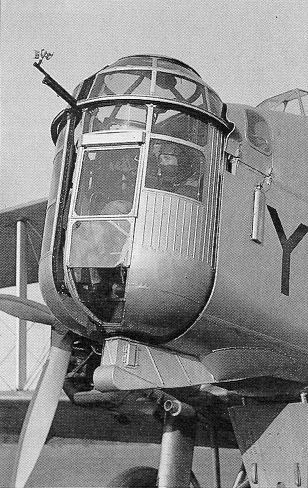
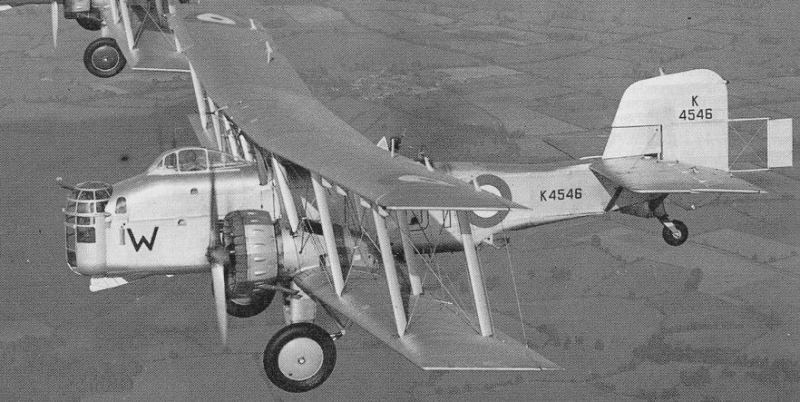
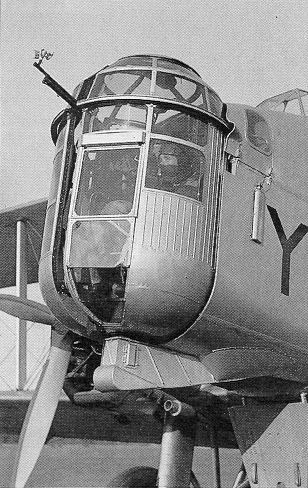
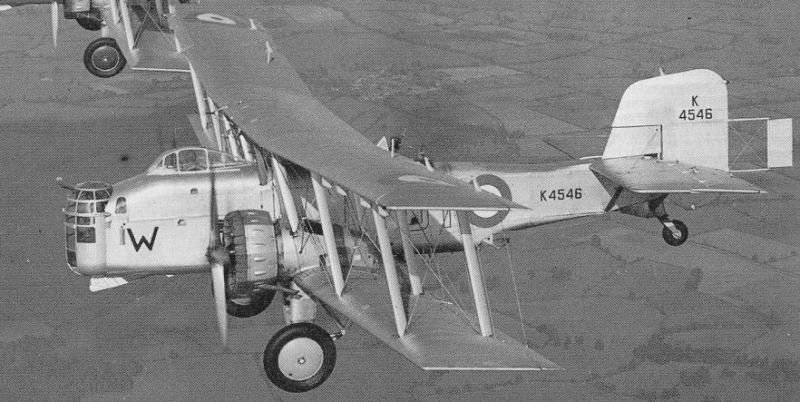
The Boulton-Paul Overstrand, a development of the earlier Sidestrand
bomber, and its nose turret. This turret was pneumatically driven
for rotation, while a hydraulic system moved the gunner's seat
up and down for elevation. The turret was cramped, as can be
seen in the close-up picture.
[71]
Initial installations of gun turrets were made in improved biplane
bombers, such as the British Boulton-Paul
Overstrand. In the mid-1930s a series of fast monoplane bombers
appeared, streamlined aircraft inspired by the new generation of
commercial transports. The Tupolev SB,
Martin B-10 showed that a substantial
performance improvement could be achieved by modern design techniques.
These fast bombers outpaced contemporary fighter aircraft. They featured
gun turrets, although simple ones, and set the trend for the next
decade.
In the 1930s the theory was developed that nothing could stop modern
bombers. As general Westover of the USAAC stated it, "no known agency
can frustrate the accomplishment of a bombardment mission." The
increased speeds of the bombers reduced the time to the target, and
because they flew higher any intercepting fighters lost more time in
climbing. This would make it impossible to send fighters in the air in
time to intercept the bomber force. Standing fighter patrols would
spread out the available forces very thinly, and if the bombers were
intercepted, their heavy armament would enable them to defeat the
attackers. Of course this thinking did not into account the development
of radar, which would provide earlier warning and would allow the
defenders to control their fighters far more effectively. It was also
wildly optimistic about the effectiveness of defensive armament. For the
moment the theory seemed sound, however. The air war in Spain, with the
infamous bombardment of Guernica, seemed to confirm it.
One of the consequences of this thinking was the development of the
"air cruiser." The logic behind the concept of the "air cruiser" was
deceptively simple: If it was assumed that bombers could defend
themselves against fighters, then it was also a good idea to create
"fighters" with a similar armament as the bombers, just more of it. They
would help to defend the bomber formation and fight for air superiority.
WWI experience with this idea was unpromising, but conflicting. A number
of multi-seat fighters had been complete failures, utterly useless in
combat. The French air force had employed the Caudron R.11, a large twin-engined three-seat
biplane, as long-range escort fighters for its bombers, and at the time
the R.11 was considered a very useful aircraft. But in fact the
formations of bombers and R.11s had suffered heavy losses on the
occasions when they operated without the escort of single-engined,
single-seat fighters!
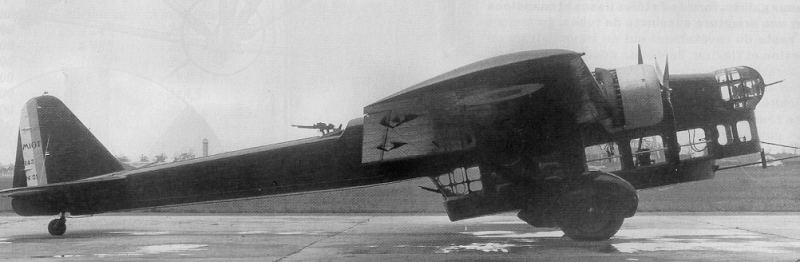
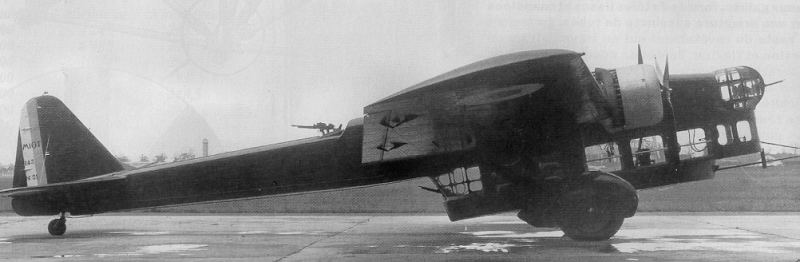
The first Amiot 143. This much-maligned aircraft was the
victim of endless delays. Designed in the late 1920s, it
was kept in production until 1938, and saw combat in 1940.
There were four gunnery stations: An upper nose turret, a
lower nose position, a dorsal position and a ventral
position.
[72]
Nevertheless, the French recreated the concept of the "multiplace de
combat", the multi-seat combat aircraft, which would operate as fighter,
bomber, and reconnaissance aircraft. Powerful armament and good
performance were of course required. The Amiot
143, the best known aircraft of this type, had none of these
characteristics, and during WWII they were unsuitable even as bombers.
But the Amiot 143 was the unfortunate victim of the fast technical
advance of the time and the unsatisfactory performance of the French
industry, which kept it in production long after it had become obsolete.
When it appeared the aircraft was quite impressive.
The Second World War
Hesitations
In 1939 many people were still convinced that the bomber will
always get through, as Stanley Baldwin had said in 1932. Devastating
air raids with chemical weapons were seen as inevitable in a modern war.
Estimates of the number of casualties that could be expected were later
revealed as far too pessimistic. Chemical weapons were not used during
WWII, although preparations were made by all sides. Nevertheless fear
for retaliation initially limited the use of bombers.
The British bomber force included both night and day bombers. There
were four main twin-engined types: The Vickers
Wellington, Armstrong-Whitworth
Whitley, Handley Page Hampden and
Bristol Blenheim. There was also a
single-engined bomber in service, the Fairey
Battle. Of these, only the Blenheim and Battle were really
classified as day bombers; the others were called night bombers. That
did not mean that they would never operate during the day, however.
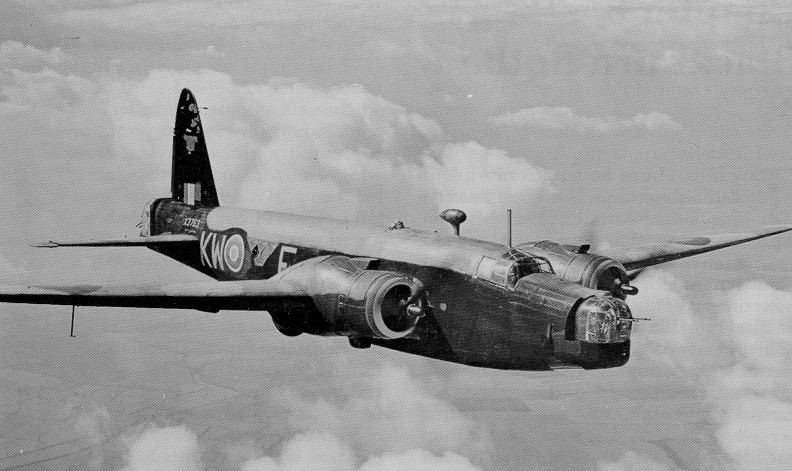
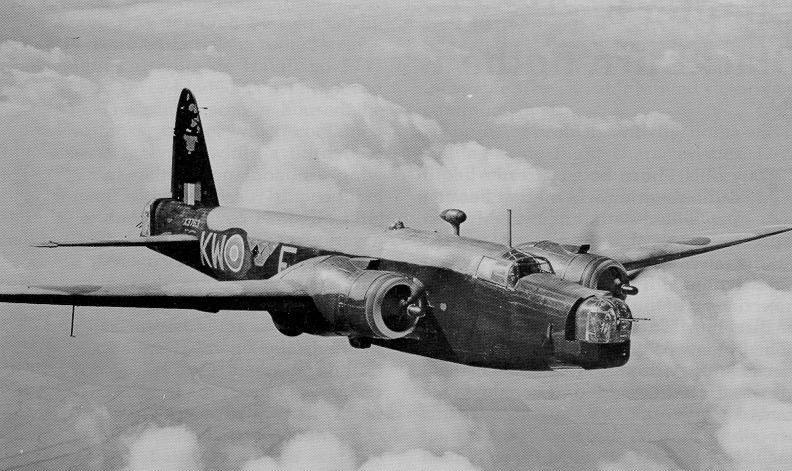
The Vickers Wellington had the characteristic nose and tail turrets of
the British night bombers, mounting Browning .303 machineguns. The
presence of these turrets largely determined the shape of the
fuselage. The windows for the beam gunners can also be seen on this
picture. Their typical shape was a consequence of the geodetical
construction of the aircraft.
[40]
The Wellington and Whitley were designed with nose and tail turrets
mounting two or four Browning .303 guns.
This became the standard pattern for British bombers, later shared by
the four-engined Stirling, Halifax and Lancaster. The Whitley also had a
rectractable "dustbin" under the belly; the Wellington initially had
one, but it was later deleted. The Blenheim had a dorsal gun turret; the
Hampden had dorsal and ventral gun positions. The Battle only had a rear
gunner armed with a single machinegun, and was extremely vulnerable to
fighter attack.
The Browning .303 was almost universal, but in manually aimed
positions one could also find the Vickers
K, a gas-operated gun that had nothing in common with the WWI
Vickers.
After the outbreak of war the night bombers began to drop leaflets,
but not bombs, over Germany. It was an useful exercise for the crews,
but of course had no military effect. Even the leaflets were primitive.
Meanwhile, German bombers attacked targets in Poland, and Warsaw, a
defended city and therefore in principle a legitimate target, was
heavily bombed. But bombing operations against Germany itself,
especially the Ruhr, remained forbidden, also because of French
opposition. With a considerably weaker airforce than Germany, the French
were understandably concerned about the German reaction.
From the start, British day bombers were allowed to operate against
warships at sea, while the Luftwaffe tried to attack the Royal Navy.
Both sides were unsuccessful. A frustrated British government allowed
attacks on warships in port, on condition that these would not result in
"disproportionate" losses. Indeed small formations of Wellington bombers
operated without loss, although also without inflicting damage, on 3 and
14 December. But on 18 December 1939, 12 out of 22 Wellingtons on a
mission to Whilhelmshaven were shot down. This did not immediately make
Bomber Command aware of the vulnerability of its aircraft. The loss of
six Hampdens and five Wellingtons on 12 April, however, resulted in a
decision that daylight bombing missions would in the future only be
flown by units equipped with the Blenheim.
Finally, on 15 June 1940, after Rotterdam had been bombed by the
Germans, the British war cabinet approved the bombing of the German
industrial center of the Ruhr. No losses were suffered through enemy
action. Night operations, at least for the moment, seemed safe. That
they were also horribly inaccurate was not known.
It is often claimed that Bomber Command tried day bombing of Germany,
and abandoned it because of heavy losses. This is incorrect. The
strategic bomber force was always intended to operate at night, and as
we have seen this policy goes back to WWI. In the early months of WWII,
the RAF just removed from day operations those aircraft that had been
designed for night operations! The Fairey Battle and Blenheim bombers
continued to operate in daylight, despite heavy losses, until the highly
vulnerable Battle was retired from combat. They were given a fighter
escort if possible, but medium and light bombers turned out to be easy
targets during tactical operations. For example, attacks on bridges over
the Meuse on the 14th of June resulted in the loss of 35 aircraft out of
71... The bombers were exposed to the German light anti-aircraft
artillery, which was very effective, and the proper tactics for escort
fighters still needed to be developed.
The Battle of Britain
After the defeat of France in the summer of 1940, the Germans were in
the position that they had won a fantastic victory in battle, but had
not won the war. The tactical mobility of the German army and the far
superior performance of its leadership had resulted in swift defeat of
the once very much feared French army. Surprised by the speed of its own
success, the German army had not planned future operations; in
particular there were no ready plans for operations against Britain. The
improvised plans that were put on the table were unsatisfactory, but
they did lead to the first attempt to achieve a major goal of war by a
strategic bombing offensive.
It is often claimed that the German airforce was purely tactical in
orientation, and that this was a major, even a fatal, flaw. It should of
course be remembered that the decisive value of tactical air support
during WWII is undisputed; while the effectiveness of the strategic
bombing offensive is still debated. In 1940 the Germans certainly had
the finest tactical airforce in the world, far superior to anything the
British or French could bring in the field.
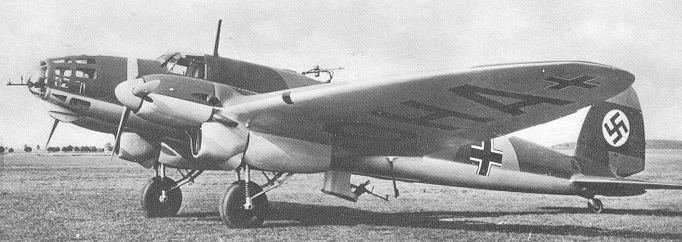
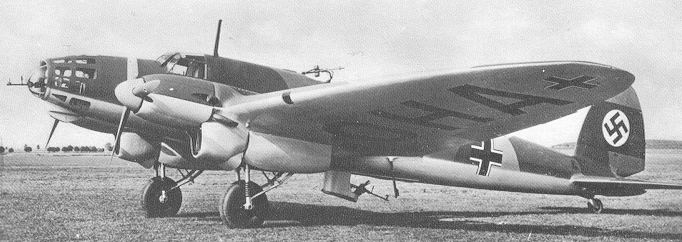
Pre-war models of the He 111 had an fuselage with a stepped nose and
wings with an elliptical planform. The dorsal gunnery position was open,
and the ventral position was a retractable "dustbin."
[44]
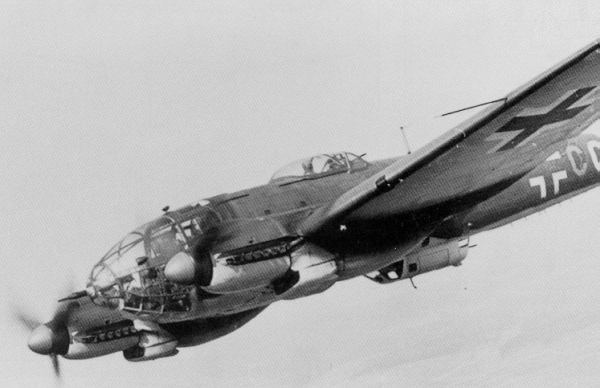
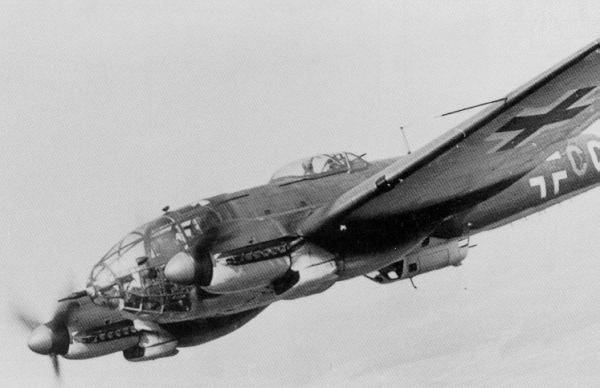
This late-war He 111H-10 has an unstepped assymetric nose and wings with
straight leading and trailing edges. The dorsal position has been faired
over, the ventral position has been replaced by a fixed "bathtub," and
the nose gun is now a 20mm cannon. A remote-controlled machinegun
was installed in the tail cone.
[74]
One would be mistaken to conclude from this that the Luftwaffe did
not consider strategic operations. Evidently, it lacked a fleet of
four-engined, heavy, long-range bombers. Preference had been given to
twin-engined medium bombers instead. Cost was an important
consideration: Germany's economic power was limited, and the larger
aircraft were also more expensive. They were not totally rejected,
however. It had been decided that the German first-generation heavy
bombers, the Junkers Ju 89 and Dornier Do 19, were unsatisfactory, and that
the Luftwaffe would wait until more advanced aircraft, such as the Heinkel He 177, were available. It is very
dubious that this decision had an important influence on the outcome of
the Battle of Britain. For the distances within Western Europe, medium
bombers had sufficient range, and this was also true for attacks on
Britain. Most British aircraft factories, for example, were located
within range of the German bombers. Given the absence of a suitable
escort fighter, the four-engined bombers would have been almost as
vulnerable to British fighters as the twin-engined ones, although
because of their greater sturdiness they might have been harder to shoot
down.
Somewhat more reasonable is the claim that the German bombers had
insufficient defensive firepower. It is hard to define what sufficient
defensive firepower would be, and if this is the kind of armament that
makes unescorted daylight operations possible, then no WWII bomber had
sufficient firepower. But one can safely say that the defensive
firepower of German bombers was smaller and less efficient than that of
their British equivalents. The Germans of course sought to cure this
defect of their bombers, and this resulted in a fantastic number of
armament variations. In general they made less use of powered turrets
than the Allies.
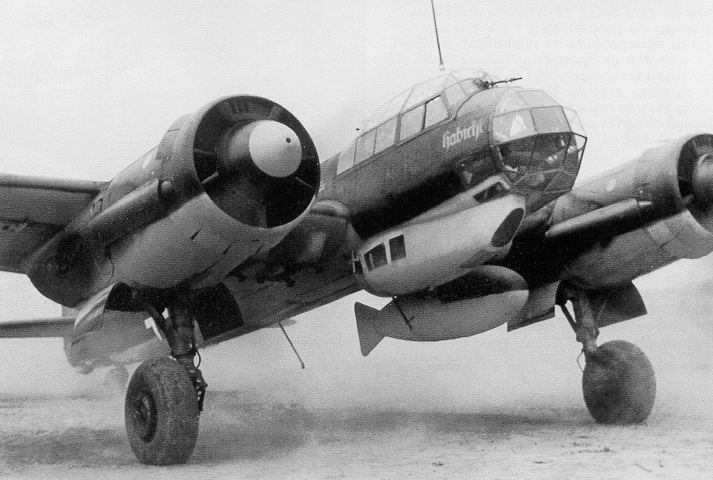
The Junkers Ju 88, a versatile aircraft with good performance.
One gun aimed was through the windscreen, and often another one
was installed for the bombardier. A gunner defended the lower
rear from the offset ventral bath under the cockpit. One or two
circular disc mounts at the rear of the cockpit provided a
defense of the upper rear sector.
[29]
At the time of the Battle of Britain, the German bombers were the
Heinkel He 111, Dornier Do 17, and Junkers Ju 88. The best German bomber was
the Ju 88. This had a crew of four, grouped together in an
extensively glazed but rather small cockpit. Defense against rear
attacks was provided by a gun position at the rear of the cockpit,
consisting of a rotating disc with a gun mount. Later two gun mounts
were installed instead of one, and the discs were armoured. To defend the
bomber against attacks from below a ventral bath was installed under the
cockpit, with another gun mount facing rearwards. The frontal defense
initially consisted of one weapon that was fired through the windscreen
of the cockpit, and later another was installed in the nose. A high
degree of interchangeability was maintained. Initially, single MG 15 rifle-calibre machineguns were installed,
but these provided inadequate firepower. During the Battle of Britain,
additional gun positions were improvised.
German Improvements?
The evolution of the German bombers was slow. One new aircraft was
introduced later in the war: The Dornier
Do 217 a newly designed aircraft to replace the
superficially similar Do 17. The old He 111 and the Ju 88
were improved, and of course received more powerful armament. In
general, the Germans avoided the use of bulky multi-gun turrets, except
in the dorsal position. Gun turrets were used, but they were carefully
streamlined. The MG 81Z twin
machinegun replaced the MG 15, and was an important step forward.
Other weapons installed in defensive positions were the MG 131 and MG-FF. Even the powerful MG 151/20 was occassionally used in flexible
installations, for example in the nose of the Junkers Ju 188.
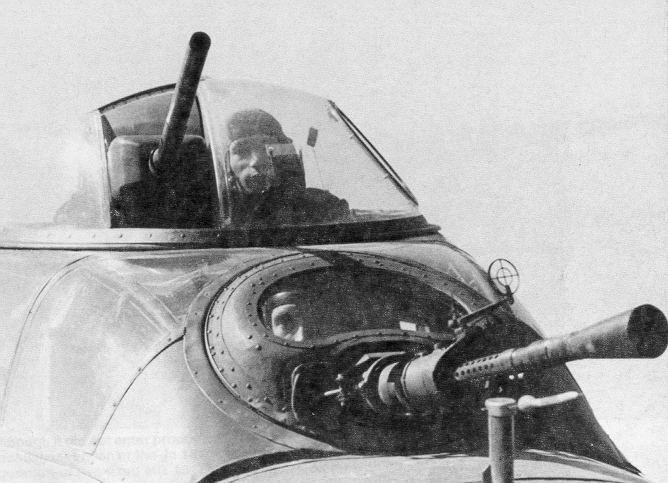
Rear defense of a Ju 188. The compact EDL turret with a single 13mm
or 20mm weapon was often deleted to reduce drag. The rotating disc
mount, heavily armoured in the later years of the war, was standard
fit on the Ju 88 as well. Note that the turret gunner has a reflector
sight, but the other one only a ring-and-bead sight.
[28]
The Luftwaffe had not ignored the need to replace its bombers by more
modern aircraft. The so-called Bomber-B program had already begun
before the war. Among the innovations included in these new aircraft
were some of the first remote-controlled gun turrets. These were
technically complicated, but they promised the best compromise between
firepower and streamlining, and allowed the gunner to be in a
pressurised cabin. But the "Bomber-B" program was a failure: It produced
an extensive series of prototypes of bombers, such as the Junkers Ju 288, but nothing more.
The twenty-two prototypes of Ju 288 had a lot of armament
variations, but the general pattern was that the defense consisted of
four remote-controlled turrets: A dorsal turret, a ventral one, one
forward-firing under the nose, and a tail turret. All were controlled
from the pressurised cockpit, by means of periscopic gunsights. (This
was a weakness, for combat experience showed that the view through
periscopic sights was much too limited.) Turrets could also be installed
on the wings. Different designs were tried, using single or twin MG 131 or MG 151/20 cannon. The intention seems to
have been to install the 20mm MG 213C
cannon as soon as it was ready, and this advanced weapon would have
given the Ju 288 considerable firepower: At 1400rpm, it fired
almost twice as fast as other 20mm cannon. But as said, the Ju 288
never entered production, and the MG 213C also remained a
prototype.
Another promising project that ultimately turned out to be a waste of
efforts was the Heinkel He 177. Its
development spanned most of the war, but the type was never
satisfactory. The He 177 represented an attempt to develop a
twin-engined heavy bomber, a decision that has been invoked derisory
comments from many authors. It must not be ignored that similar attempts
were made by the British, who developed the (equally unsuccessful) Avro Manchester. The engines of the He 177
were created by coupling two DB 601 or DB 605 V-12 engines to
drive a single propeller. Although this was a source of problems, the
idea was far from unreasonable: In the USA, Allison made a similar
coupling of two V-1710s to create the V-3420 engine. One serious error
was made, however: A lot of time was wasted in an attempt to make the
He 177 suitable for dive bombing. The dubious potential for
greater accuracy did not justify the enormous structural problems this
generated for such a large aircraft. The idea was abandoned, but not
before it had caused delays.
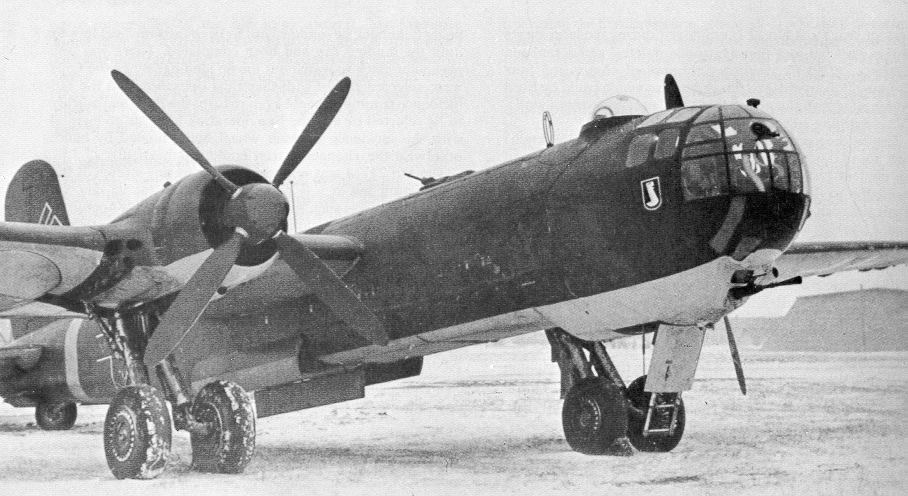
The nose of a He 177A-3/R1. The armament installation is almost
schizophrenic: The weapons in the tray under the cockpit and the
turret behind the cockpit are remote-controlled, but there is also
a manually aimed MG 81, pointed through the small circular
opening in the cockpit glazing...
[41]
The He 177 can perhaps best be described as the German
equivalent of the Boeing B-29
Superfortress, although inferior in overall performance. Both
aircraft were technically advanced and complicated. Both had an
inauspicious early career, and for the same reason --- engine fires. Both
aircraft featured a fully glazed nose, instead of a stepped cockpit; a
feature that was relatively common for German bombers. And both featured
remote-controlled armament, although that of the He 177 was far simpler.
In effect only the guns in the tray under the cockpit and the first of
the two dorsal turrets, with two 13mm machineguns, were
remote-controlled. The second turret, with the same armament, was
manned. It is unclear why the designers chose this strange arrangement.
The He 177 also had a tail turret, and a single gun fired through the
nose glazing. In several versions, the tray under the cockpit was used
to install powerful, fixed guns.
More prototypes of advanced bombers were built; the best known was
the Messerschmitt Me 264
Amerika-bomber. But in the end, German attempts to replace the
bombers with which the Luftwaffe had entered the war were failures. The
short range of the German fighters, and the need to concentrate the
available fighters for home defense, also ruled out an effective fighter
escort. The German bombers were increasingly forced to seek the
protection of the dark.
Night heavies
RAF Bomber Command evolved in quite different direction, although it
also operated at night. A new generation of four-engined bombers
replaced the Hampdens, Wellingtons and Whitleys. The first of them was
the Short Stirling, but the Avro Lancaster became the mainstay of Bomber
Command and the Handley Page Halifax its
second most important bomber. The success of the Lancaster and Halifax
was almost an accident. Both had initially been designed as
twin-engined bombers to specification P.13/36. The design of the
Halifax was converted to four engines while still on the drawing board,
while the Lancaster was a four-engined development of the twin-engined
Manchester. But because P.13/36 had called for the carriage of
torpedoes, both retained a capacious, unobstructed bomb bay.
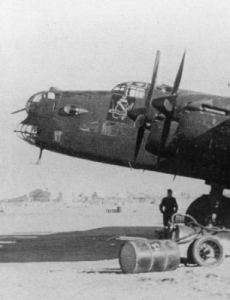
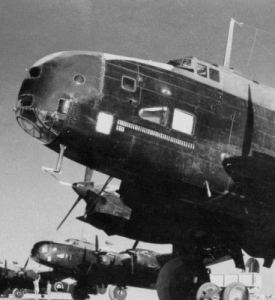
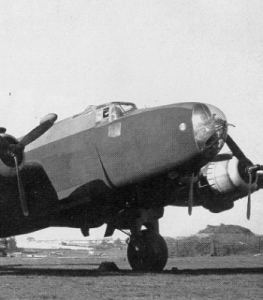
Evolution of the Halifax nose. The original twin-gun turret
was soon deleted and replaced by the "Z" fairing; this reduced
losses by improving performance. Later a simple perspex blister
with a single gun was designed.
[42]
As first built, the Halifax had four Boulton-Paul gun turrets: A
four-gun turret in the tail, and two-gun ventral, dorsal and nose
turrets. But this apparently logical and effective arrangement did not
survive long. The ventral turret was soon deleted because it was
difficult to operate, although it was optional on some later Halifax
marks. To reduce drag, the nose turret of the early versions was at
first deleted and simply faired over, and later replaced by a perspex
nose with a single manually operated Browning or Vickers K gun. The tall
dorsal turret was also often removed, and even when it was replaced by a
more compact one with four machineguns, also a Boulton-Paul product,
this was sometimes omitted. The absence of the dorsal turret could be
compensated, to some extent, by installing beam guns: Single or twin
Vickers K machineguns on each side, pointed through windows in the
fuselage. The only gun turret that was always retained was the tail
turret.
The Lancaster had Frazer-Nash turrets, initially in the same
arrangement as on the early models of the Halifax. The Lancaster
happened to have much better aerodynamics than the Halifax, and the
great majority of Lancasters retained their nose, dorsal and tail
turrets. The ventral turret was deleted, and on many aircraft it was
replaced by a fairing for the H2S radar.
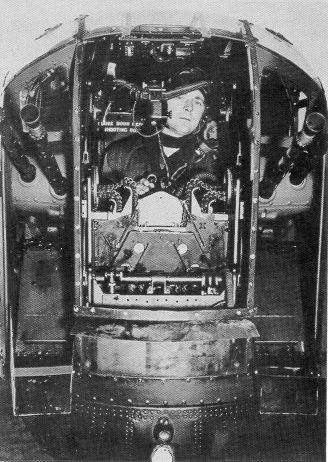
Four Browning .303 machineguns were installed in the tail
turret of a Lancaster. The gunner also had the best view
towards the rear, where any attacker was likely to appear,
and he controlled the defense. On his signal the pilot
would start the evasive "corkscrew" manuever.
[32]
The absence of any form of ventral armament would make the
four-engined bombers very vulnerable to the upward-firing Schräge Musik installations, used by German
nightfighters with devastating success in the winter of 1943-1944. The
nightfighter, flying below the bomber, would have been very difficult to
see anyway: It is not certain that the presence of ventral guns really
would have made a large difference. Nevertheless, it can be argued that
the absent ventral armament would have been far more useful than the
nose or dorsal guns.
Another concern was the continuing use of the .303 machineguns as
bomber armament, although .50 guns were occasionally installed. After
the first years of the war most fighters had armour plating and
windscreens that rendered the .303 ineffective. But it was not that easy
to redesign the gun turrets for heavier weapons, and to make things
worse no British .50 was available. American Browning .50s were
apparently not in sufficient supply to re-arm Bomber Command's aircraft
entirely. And the 20mm Hispano was a slim, but long and heavy weapon,
not ideal for installation in a gun turret.
The protection of the night soon turned out to be a very relative
one. The development of better radars by the Germans could make night
attacks almost as costly as unescorted daylight attacks. Night bombers,
it turned out, also needed escort fighters. After a disastrous attack on
Nuremberg in March 1944, in which 95 bombers (11.9%) were lost, Bomber
Command at last received three additional squadrons of Mosquito
nightfighters, two of them equipped with the new centimetric radar, in
addition to the three squadrons of Serrate-equipped fighters its
already had (See note 6). Nightfighter
operations and successful jamming of German radars and communications
soon helped to keep losses to an acceptable level.
But the de Havilland Mosquito was a
bomber as well as a nightfighter. Calculations showed that the unarmed
Mosquito, relying on speed and altitude to evade German fighters, was a
more efficient way to deliver bombs to the target than the four-engined
"heavies". Not carrying armament resulted in enormous savings in weight
and drag, reduced the crew to two, and reduced the cost of the aircraft.
This resulted in the creation of the Light Night Strike Force.
Evidently, a bomber that relied purely on high performance was
vulnerable to technical developments; but the Mosquito was a brilliant
design, and remained extremely difficult to intercept throughout the
war. Only at its very end the Germans managed to put a small number of
jet-engined nightfighters in service.
The 8th AF
In July 1942 the first aircraft of the 8th Army Air Force arrived in
Britain. Initially the American commanders restricted themselves to
cautious attacks on targets within the range of the available escort
fighters, but soon they ventured beyond the range of the escort
fighters. On 27 January 1943 a target in Germany was attacked for the
first time: 91 heavy bombers attacked Wilhelmshaven and Emden.
All precedents indicated that unescorted daylight attacks would
result in heavy losses of bombers, but the leaders of the 8th AAF
nevertheless adopted this as a tactic. They believed that only daylight
attacks could have the precision needed to take out the German war
industry. Day bombardments, Ira Eaker argued, were five times as
accurate as night bombardments; and in 1943 this was probably true. Only
later in the war, when better navigation aids became available and
marking techniques were improved, did night bombardments rival
the accuracy of day bombardments. Besides, the 8th AAF was a day bombing
force, and switching to night attack would have required a complete
reorganisation, re-training and re-equipment.
The answer to the fighter treat, it was believed, was to have more
and heavier guns per bomber, attacks by fleets of 300 or more bombers, and
close-packed formations that were carefully arranged to give each gunner
the best possible field of fire. The "combat boxes" would be able to
bring more firepower to bear on the enemy fighters than any bomber
formation had ever done before.
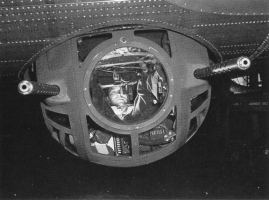
Only small men would fit in the ball turret of a B-17. Although
uncomfortable, this was a much more effective defense than
remote-controlled weapons with periscopic gunsights, and it
caused less drag than a "dustbin" turret.
[32]
The Boeing B-17 Flying Fortress and
Consolidated B-24 Liberator certainly were
heavily armed. In the first versions, the armament of the "Flying
Fortress" had consisted of only five manually operated machineguns, an
arrangement that invoked sharp criticism from the British, who
considered the aircraft "practically indefensible against any modern
fighter."[34] But when the 8th AF began
operations, the US heavy bomber had been redesigned, taking
into account the combat reports from Europe. They had dorsal turrets and
ventral "ball" turrets with two Browning .50 M2 machineguns. A tail
gunner controlled two more .50s. Two windows in the waist of the
aircraft each accomodated a single .50 gun. In the B-17 another single
.50 was fired from the radio room. Of course all this armament was
rather heavy, to a total of over 2580 kg (5700 lb),[66] and that was more than the bombload on
long-range missions. In principle this gave them excellent defensive
firepower in the entire rear hemisphere. Optimists declared that it
meant "almost certain death" for any enemy fighter to approach a Flying
Fortress.[67]
The front was a weak point, however. Although the prototype had had
a nose turret, the frontal defense of the production B-17 was limited to
a number of manually aimed machineguns, initially a single .30
machinegun; it was soon replaced by a .50, and one or two more .50s were
installed in small "cheek" windows. The B-24 had similar armament. This
was not enough, because the Germans soon understood that the B-17 was
really vulnerable to frontal attack. Not only was the forward firepower
limited, there was no armour to protect the crew from such attacks. The
German pilot Anton Hackl commented:[11]
| One accurate half-second
burst from head-on and a kill was guaranteed.
Guaranteed! |
The Germans concluded that in a head-on attack, four or five 20mm
hits would destroy a bomber, while it usually required more than 20 hits
when attacking from another angle. Of course the head-on attacks were
difficult to set up, and required very experienced pilots. But clearly
something had to be done. The cockpit windows were soon replaced by
laminated armoured glass,[65] and the
nose armament was increased. At first units in the field improvised more
powerful nose armament, but the B-17G and B-24H introduced powered nose
turrets with two .50s.
These nose turrets were a fortunate spin-off of new experiments with
the "air cruiser" concept: The YB-40, a heavily armed "escort fighter"
version of the B-17, and the XB-41, a similar version of the B-24. Only
one prototype of the XB-41 was completed, but twenty-one YB-40s were
created. Combat experience showed that the YB-40s with all their
additional armament, armour and ammunition were too slow to maintain
formation with the B-17s, and that ended the experiment.
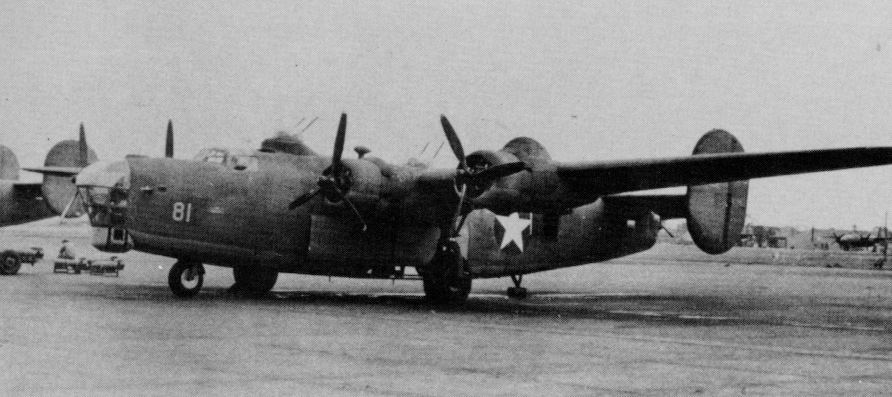
The single XB-41. Note the two dorsal turrets and the chin
turret, B-17G style. Waist gun positions were fitted with two
power-operated guns each. This was not just a bad idea, the
aircraft had poor flying characteristics as well.
[32]
Even the best all-round armament was never enough. Deep penetrations
in German territory turned out to be extremely costly. The most famous
examples are the attacks on Regensburg and Schweinfurt: The first
attack, on 17 August, resulted in the loss of 60 bombers out of a force
of 363. Some consolation was found in the claims by the gunners, which
amounted to a total of 228 enemy fighters shot down; even after careful
evaluation of claims the 8th AF estimated the German losses to be
between 148 and 100. In fact the Luftwaffe had lost only 25 fighters. A
repeat attack on 14 October gave a confirmation, if any was necessary:
65 more B-17s were lost. The initial claim of enemy fighters downed was
even higher than in the first attack, 288; but even the official figure
of 104 was way above the real German loss: 35. (See Note 3.)
The infamous attacks on Schweinfurt were not unique. They were merely
the most serious in a long series of disasters for the 8th AAF. In 1943,
it was clearly losing the battle with the German fighter defenses.
Why did the heavy bombers fail? Apparently the leaders of the 8th AF
simply underestimated the difficulty of the task the gunners faced.
There were some skeptics, such as Col. Claude E. Putnam, the commander
of the 306th BG, who estimated in 1943 that only 10% of the gunners who
could theoretically have fired at an enemy aircraft really did so, and
that at least four gunners needed to fire to have a 50% probability to
shoot an enemy aircraft down. The commander of the 308th shared his
doubts, wondering whether the guns were not more a hazard than a
protection.[35]
The attacking fighters were small targets in an often confusing
battle, and it was not at all evident that gunners would see them,
identify them, estimate their distance and speed, aim correctly, and
fire at the right time. This looked good on paper, but in practice it
was an almost impossible task. During WWII, the hit probability for
fixed, forward-firing guns was estimated to be only about 2% for an
average pilot; and the operation of flexible guns is far more complex.
The German fighter pilots flew short missions; the gunners spent long
hours in cold, draughty, and incredibly noisy aircraft, shaking in the
turbulence created by the large bomber formations. The gunsights were
often primitive: The powered turrets had some form of computing sight,
but most hand-aimed guns had simple ring-and-bead sights. The field of
view and fire from some positions, notably the radio room of the B-17
and the waist positions, was quite limited. Overall, the German fighters
held a clear advantage.
Another factor was that the gunners were not trained well enough.[27] After the outbreak of war a large
training program was created, but there was little experience in the
field, little equipment, and it was very difficult to find and retain
competent instructors. During the war some improvements were made, but
as late as 1944 a War Department report admitted that some gunners
simply didn't know how to operate their gun turrets! Operational units
had priority for equipment, and gunnery training was sadly neglected: It
was mid-1944 before enough aircraft were made available to gunnery
schools and gun cameras became available for training purposes.
The assumption that the concentrated fire of a "combat box" would
fend off fighters also had a fundamental flaw: It ignored that the
fighters would react by concentrating their attacks. Initially the
Luftwaffe went after the lower groups, but later it often attacked the
lead group, because they knew that it contained the lead bombardier. The
formation did offer significant protection to the bombers; indeed any
bomber that left the formation became an easy kill. But it was not
enough.
The exaggerated kill claims gave a false impression of the
effectiveness of the defensive guns, and for this reason the 8th AF
continued unescorted daylight attacks for far too long. The usual reason
given for the excessively high claims is that any German aircraft shot
down was claimed by multiple gunners, who had all fired in its
direction. In addition, too often any puff of smoke from a German
aircraft was interpreted as a sign of a fatal hit, while it often enough
just indicated a rough handling of the throttle. The gunners had to do
an impossible job in extremely dangerous conditions, and can hardly be
blamed for compiling incorrect statistics.
Bombing Japan
The Boeing B-29 Superfortress was
probably the best bomber of WWII. It set new standards in range, bomb
capacity, speed, altitude, and crew comfort. It also introduced a new
armament installation. The weapons installed were the traditional .50
Brownings; an additional 20mm cannon in the tail position was often
deleted. It was the control system that was new. The two dorsal and two
ventral turrets were remote-controlled by a computer system. All had two
guns, but the front dorsal turret was later replaced by a four-gun
turret. The gunner worked in transparant domes, feeding data into the
computer by tracking the target with their gunsight. One or more turrets
could then be assigned to fire. Only the tail guns were controlled
directly by their gunner.
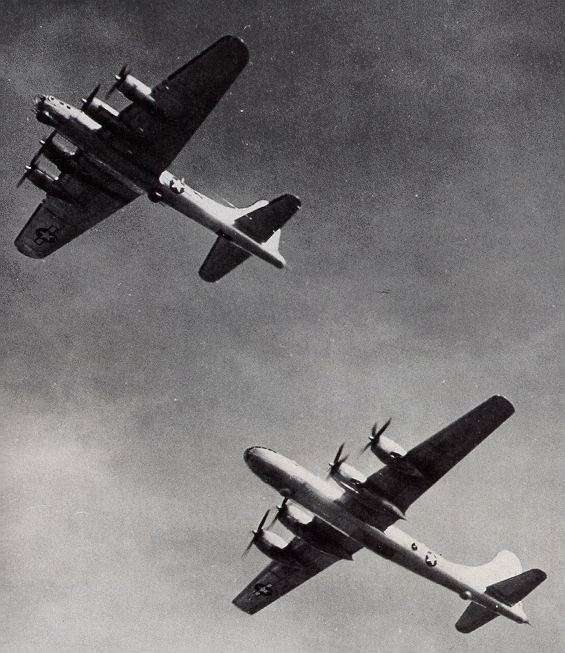
A B-17 and a B-29. The family resemblance is obvious. The cleaner
aerodynamics of the B-29 are greatly helped by remote-controlled
turrets. Originally retractable turrets with periscope sights were
specified, but these turned out to be impractical.
[72]
Primitive by modern standards, this was the most advanced system
fitted to any WWII bomber. Whether it was effective enough to defend the
B-29 against enemy fighters is dubious: The Japanese air defenses were
poorly organized and poorly equipped for their task, but in December
1944 they began shooting down four or five B-29s on every operation. Yet
the unreliability of the B-29's engines was still a more serious problem
than the Japanese defense. Accuracy was poor too, because US
meteorologists had insufficient knowledge about the jetstream, the fast
high-altitude wind which disrupted formations and invalidated the
calculations of the navigators and the bomb aimer.
Confronted with the failure of the high-altitude daylight attacks,
general Le May made the drastic decision to switch to night attacks at
relatively low altitude. Most of the defensive armament of the B-29s was
removed to save weight. Because the climb to high altitudes would no
longer be made, less fuel was needed and the unreliable engines were
spared. The weight savings were converted in a larger bomb load, with a
lot of incendiary bombs. Le May in effect adopted British tactics and
methods for his bombers: He did exactly what the 8th AF had always
refused to consider. Of course the Japanese did not have a very
effective light anti-aircraft artillery; nor did they have a substantial
and effective nightfighter force. These tactics were thus even more
suitable over Japan than they had been over Germany. The effect was
devastating. The bombing of Tokyo on 9 March 1945 is generally
considered the most deadly of the war. More people were killed than in
the British bombardments of Hamburg or Dresden; more too than in the
nuclear bombardment of Hiroshima and Nagasaki. Such indiscriminate
slaughter of tens of thousands of people was against US policy, but
Le May justified it by pointing out the highly dispersed nature of
the Japanese war industry, which meant that almost everyone contributed
to it.
Cold War Bombers
When the Soviet military entered Germany at the end of WWII, it was
aghast at the degree of destruction caused by Allied bombing of German
cities. The enormous fields of ruins were a clear reminder of the might
of the Allied strategic bomber forces. The fact that, at the time, only
the USA possesed nuclear weapons made this only more frightening. The
strategic bomber became the main weapon of interest during the first
years of the cold war. For the USA and Britain, this required a
reorganisation and re-equipment of their existing forces. For the USSR,
which did posses only a very small force of long-range bombers, it
implied the creation of an entirely new force.
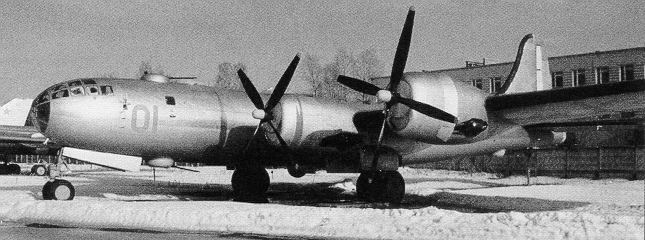
Tupolev Tu-4. It is often claimed that this was a bolt-for-bolt
copy of the B-29, but much of it was redesigned, including the
defensive armament, the bomb bays, the engine installation, and
the fuel cells.
[3]
Although the USSR would have been able to design its own long-range
bomber, Stalin chose to use three Boeing B-29s as starting point. These
aircraft had made emergency landings on Soviet territory during WWII, and
because the USSR was not at the time at war with Japan, the aircraft had
been interned. A reluctant Tupolev was given two years to create the
Soviet version, which had to be thoroughly re-engineered to make its
production possible. A lot was learned in the process, although some
techniques used in the B-29 remained beyond the reach of the Soviet
industry. In one field, that of aircraft guns, the USSR was ahead of the
USA; and the Tu-4 was armed first with
20mm B-20 cannon, and later with 23mm NR-23 guns, instead of the American
Browning .50.
While a Tu-4 or a B-29 with a nuclear weapon presented a significant
threat, they were hardly intercontinental bombers. Besides, the
vulnerability of the B-29 was demonstrated in Korea, where the USAF,
lacking an escort fighter that could match the MiG-15, was forced to
abandon daylight B-29 operations. A true intercontinental bomber with a
better performance was needed. Work on such an aircraft had been
underway in the USA since 1941, inspired by the possibility of
operations against Germany without the availability of bases in England.
The Convair B-36 was a giant six-engined
aircraft, armed like the B-29 with guns in remote-controlled turrets.
The firepower had been increased by using the M24, a 20mm cannon based
on the wartime Hispano.
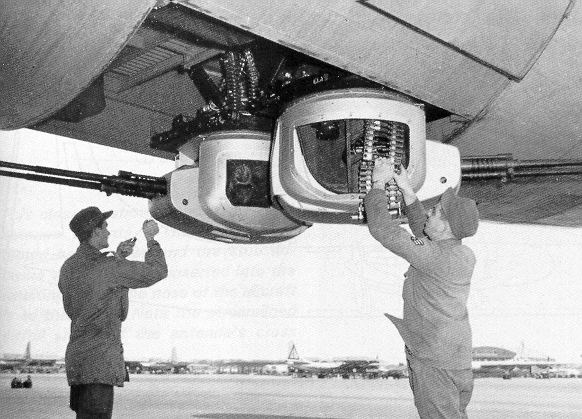
Ventral guns of a B-36. Its sixteen M24 cannon were installed in pairs
in remote-controlled turrets.
[43]
But later the USAAF reversed this policy. Under project
Featherweight III, all defensive armament was removed from the
B-36, except the tail guns. It was felt that the heavy and
maintenance-intensive guns would not be enough to protect a B-36 against
attack. On the other hand, by removing the armament and other equipment
the operational ceiling could be raised to 47,000 feet (14.300 m) or
higher. Contemporary jet fighters had difficulty to reach and maintain
such altitudes, and the enormous bomber was more manoeuverable than the
fighters at high altitude, because of its generous wing area.
One reason for the smaller desirability of defensive armament was the
change in tactics, brought about by nuclear weapons. No longer was there
a need for large formations of bombers: A single aircraft could destroy
a city. And a single aircraft could not hope to defend itself against
enemy fighters, but it might be able to evade them. The attackers in a
nuclear war would disperse themselves to attack individually, thus
making the task of the defenders much more difficult. In the 1950s
bombers had the additional advantage that the rapid drag rise in the
transsonic region made it very difficult for fighters to be much faster
than the bombers.
Most of the bombers of the nuclear age therefore abandoned defensive
armament, at most retaining a few tail guns. In Britain a successor to
the Mosquito entered service: The Canberra,
a fast and unarmed twin-engine jet aircraft. The Canberra was almost as
versatile as the Mosquito had been, but as bomber it was only an
intermediate solution. The British deterrence was to be constructed around
the four-engined V-bombers, the Valiant,
Victor and Vulcan. These too were unarmed, relying on speed,
altitude, and an effective ECM suite. When SAMs became an effective
defense against high-flying aircraft, the tactics were changed to
operations at low altitude.
American bombers such as the B-47 , the
supersonic B-58 Hustler, and the
eight-engined B-52 Stratofortress retained
their tail guns, but no other defensive armament. ECM suites, decoys and
stand-off weapons were hoped to keep the enormous, but vulnerable B-52
out of harm's way. The B-1B Lancer and
B-2 Spirit abandoned all armament, but
introduced stealth in addition to the other tricks.
The big exceptions came from the USSR, where the trend to abandon
defensive armament also set in, but much slower. Remote-controlled
turrets, B-29 style, remained important on Soviet bombers. The weapons
installed in them were usually 23mm cannon, at first the AM-23 which was availiable in short-barrelled and
long-barreled versions, and later the twin-barrel GSh-23M cannon. The Tupolev
Tu-16 Badger jet bomber of the early 1950s retained a
dorsal, a ventral, and a tail turret. When the enormous
turboprop-engined Tupolev Tu-95 Bear
first flew a few years later, it had two dorsal and two ventral turrets
in addition to tail guns, but on the Tu-95M production aircraft the
forward upper and lower turrets were removed. On the redesigned Tupolev Tu-142 of the late 1960s all dorsal and
ventral turrets were finally deleted. The jet-engined Myasichew 3M Bison that was the main
competitor of the Tu-95 also had ventral, dorsal and tail turrets. On
the other hand the supersonic Tupolev Tu-22
Blinder and Tupolev Tu-26
Backfire conformed more to modern practices, having only
radar-controlled tail guns.
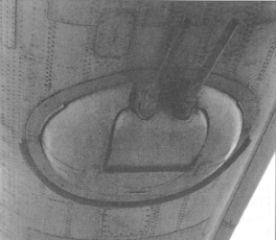
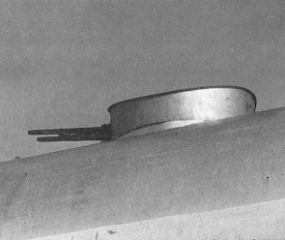
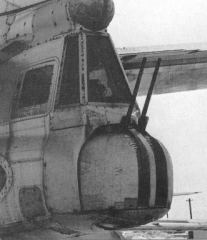
Armament of a Tu-95: A compact non-retractable ventral turret,
a retractable dorsal turret, and a tail turret. Also note the
gunlaying radar above the gunner's cabin.
[75]
An exclusively Soviet practice is the installation of defensive tail
guns on large transport aircraft. Military versions of the Ilyushin Il-76 Candid can be distinguished
from civilian version by their tail turret mounting twin GSh-23 cannon.
Similar installations were made on the older Antonov aircraft, such as
the An-8 Camp and An-12 Cub. But no tail guns were installed
on the giant An-22 Cock, and they
are also absent from Antonov's later twin-engined transports. Possibly
the use of tail guns on Soviet transport aircraft was primarily related
to their role as paratroop carriers, which would bring them over the
frontline.
Next: Postscript
© 1998-1999
Emmanuel Gustin
gustin@uia.ua.ac.be
visitors since 23 December 1998.
This page hosted by 
Get your own Free Home Page
|