Precedents
Early Experiments
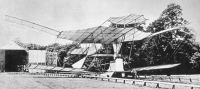
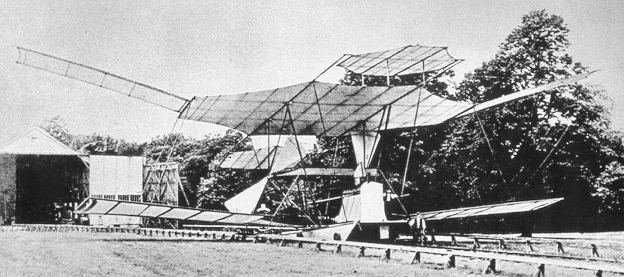
Sir Hiram Maxim's experimental biplane. The inventor can be seen
standing in front of the aircraft, between the guidance rails.
The monster was powered by advanced, light and powerful steam
engines.
[33]
In a sense the association of the aircraft and the machinegun began
before the first existed. The first automatic machinegun was developed
by Sir Hiram Maxim, and it was used in the colonial warfare of the late
19th century. Maxim devoted some of his wealth to the construction of a
giant steam-powered biplane, tested in 1894 in Britain. He was wise
enough to try to keep the aircraft under control with guiding rails,
that allowed it to raise only a few centimeters above the ground. But
during a test the rails broke and the aircraft was destroyed.
It is not known whether Maxim envisaged that his guns would be fitted
to aircraft. The early aircraft were much smaller than Maxim's 3.5 ton
giant, and the weight of the gun and its ammunition was a heavy burden
for small aircraft with limited engine power. The development of more
powerful aircraft was only a matter of time, however. Rifle-calibre
machineguns were not that heavy, and the weight could be reduced by
deletion of water-cooling jackets and circuits: On aircraft air cooling
was sufficient. The jacket was often retained, but perforated to reduce
the weight and improve cooling.
The problem then became the development of a suitable gun mount. We
will skip over the problems of observer guns,
and only consider forward-firing guns. There was no real problem on
aircraft with a pusher engine: The machinegun could be put in the nose.
However, such aircraft had a complicated design with tailbooms around
the propeller; this was heavy and induced a lot of drag. Therefore, the
performance of pusher aircraft was usually inferior to that of the more
compact tractor designs. At first this was not a serious problem. At the
start of WWI the French even decided to equip their air force entirely
with pusher designs, simply because this would make it easier to
distinguish friend from foe: The Germans employed mainly tractor
aircraft.
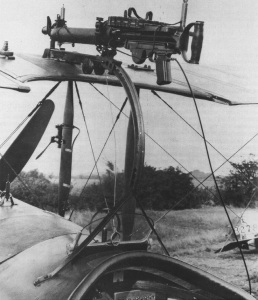
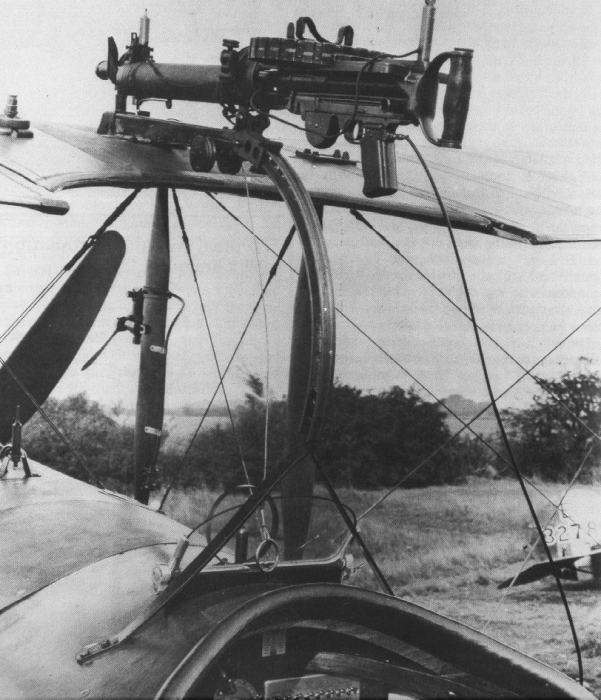
Left, the Foster mount on an SE.5a. When this aircraft entered
service the Foster mount was obsolescent, but it did have the
advantage that it could be used to fire upwards.
[4]
On tractor designs, with the propeller in front, the gun could in
principle be fitted outside the propeller circle. On two-seat monoplanes
a high gun mount could be installed, and the gunner could stand to
fire over the propeller: It was tried on some aircraft, but it was not a
good solution. On biplanes the machinegun could be installed on top of
the upper wing. Unfortunately the gun was then out of the reach of the
pilot, and WWI machineguns were rather unreliable. Pilots needed to
clear stoppages frequently, and often carried a small hammer for this
purpose. For drum-fed weapons, such as the Lewis, there was also the
problem of changing drums: Flying the aircraft with one hand while
handling a heavy ammunition drum with the other was a difficult task,
and many pilots chose to break off combat and descend to lower altitude
before attempting to do this. Finally, the recoil of the gun was enough
to disturb the aim. Nevertheless this arrangement was used by some
Allied aircraft, using a Lewis gun, because this was more reliable than
the Vickers. Later the so-called "Foster mount" was installed on SE.5a
fighters. This was a curved rail that allowed the pilot to slide the gun
backwards and downwards.
The final alternative, the most practical one but also the
technically most complicated one, was to install some form of
interruption or synchronisation mechanism, so that the machinegun could
fire through the propeller disc. Several such mechanisms had been
designed before the war. The Swiss engineer Schneider, who had worked
for Nieuport in France and LVG in Germany, patented his design, of which
drawings were even published in The Scientific American. In
Russia, Poplavko experimented with synchronisation in 1913. In Britain,
the Edwards brothers patented another gear, and demonstrated a working
model. The French engineer Saulnier also worked on synchronisation, but
he discovered that the Hotchkiss machinegun fired too irregularly: It
was not suitable for synchronisation. Far too often a round would "hang"
and put a bullet in the propeller. As a safeguard, the French had
developed wedge-shaped steel deflectors that were fitted to the propeller to
protect it, but the results were not encouraging.
Despite all this experimentation before the war, the the French and
British air services entered the war with only two machineguns each, and
the Germans had none. Therefore, the first shots in air warfare were
fired with pistols and rifles, very unsuitable weapons for this kind of
combat, but readily available to the crews, who often came from infantry
or cavalry units. The RFC (Royal Flying Corps) authorized only the
standard service rifle, a far too unwieldy weapon. Apparently the
British pilot Lanoe G. Hawker was the only one to win any victories with
a carabine.
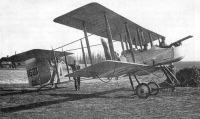
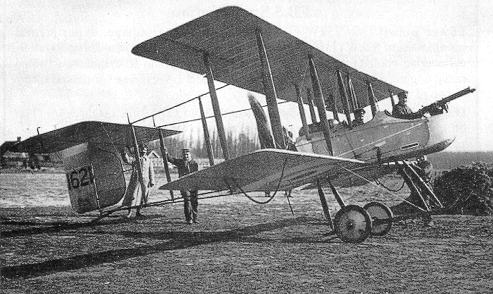
A Vickers F.B.5 captured by the Germans.
[61]
The pusher design was the first to be applied. Already in September
1912 Vickers had tested a biplane with a machinegun. By 1913, Vickers
had developed the EFB.2, perhaps the
world's first purpose-designed fighter aircraft. The EFB.2 was a
two-seat pusher biplane, so that the gunner in front had a free field of
fire. The installation of the Vickers machine gun, in a fairing in the
tip of the nose, was entirely unpractical. By June 1914 a more practical
gun mount had been developed, but it was July 1915 before the first
Vickers FB.5, nicknamed "Gun Bus", appeared
in France! Unfortunately the Vickers was underpowered and slow, and the
machinegun initially so unreliable that many gunners took a rifle with
them anyway.
A similar installation was made on some French Voisin biplanes, with Hotchkiss machineguns that
were operated by the observer. The pilot sat in the front seat, and the
observer fired the gun over his head. On 5 October 1914 a Voisin piloted
by Joseph Frantz and with Louis Quenault as observer shot down a German
Albatross biplane. It was the first victory in the air. By February 1915
the French had installed about 50 machineguns on their aircraft: Not
very much, but enough to force the German aircraft to a hasty retreat
whenever they appeared over the battlefield.
A fixed machinegun on a single-seater would be even more effective.
The famous pilot Roland Garros dispensed with the synchronizing gear
altogether, and installed a machinegun and deflectors on his Morane-Saulnier L, a parasol monoplane. His mechanic
worked hard to improve the design of the deflectors. Starting on 1 April
1915, he shot down five German aircraft in seventeen days, before he and
his aircraft came down behind the lines and were captured by the
Germans. His success was so convincing that the Morane L and N, equipped
with fixed guns and deflectors, soon equipped three French squadrons and
some RFC units.
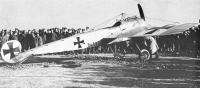
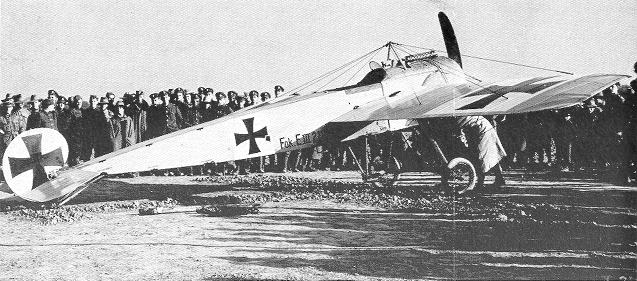
Fokker E.III.
[22]
In Germany, the aircraft manufacturer Anthony Fokker was asked to
deliver a synchronisation mechanism. Engineers Heinrich Luebbe and Fritz
Huber were already developing a suitable mechanism, and after a few days
Fokker could demonstrate the prototype. (The Fokker mechanism infringed
Schneider's patents, and the legal battle would continue until
Schneider's death.) The result of this experiment was the Fokker E.I, a modified M.5K monoplane with an
Oberursel rotary engine, and a single fixed forward-firing machinegun.
The first Fokker Es were delivered in the summer of 1915, and came in
the hands of pilots such as Boelcke and Immelmann. The Fokker E.I, and
the improved E.II and E.III, did not have a very good performance, but
their armament was very effective. One or two fixed forward-firing
machineguns became the standard armament for the fighters of World War I
and the interbellum, usually installed on top of the front fuselage.
The Fokker became famous, but already before it entered service the
Allies had put in production superior designs: The Airco DH.2 pusher, and the Nieuport 11 with the machinegun on the upper
wing. Hence the Fokker Scourge was relatively brief. Far more
deadly were the Albatross biplane fighters,
with two synchronized machineguns. They took a heavy toll in "bloody
April" of 1917, and set the standard pattern for the rest of the war and
the interbellum.
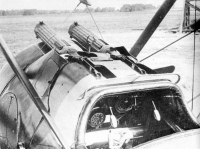
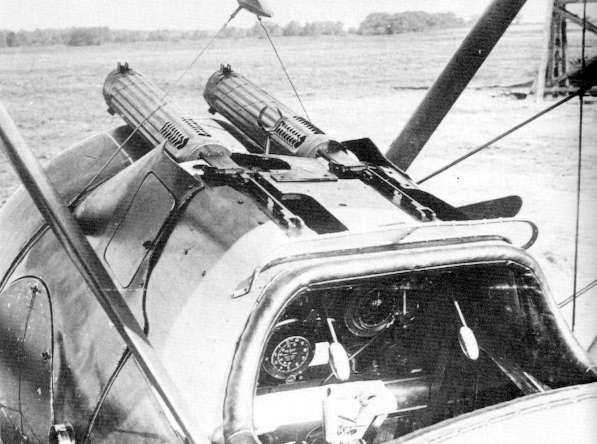
The Sopwith F.1 biplane fighter received the name Camel
because of the hump that covered the two Vickers guns.
The fairing was often partially cut away to make it possible
to clear stoppages in the air. Note the loading handles in
the cockpit.
[23]
There was a wide array of different synchronisation mechanisms. The
early ones were not very reliable, and accidents were common. The most
successful was the C.C.-gear, named after its inventors Constantinesco
and Colley. This operated with an hydraulical instead of a mechanical
link, and that gave much more flexibility. The C.C.-gear could be used
with any engine and any machinegun.
A refinement that was useful for air combat was the development of
incendiary ammunition, but this was not without danger: The earliest
German incendiary ammunition was so unreliable that it could seriously
damage the aircraft that fired it. The quality of ammunition was a
problem throughout the war, and a wise fighter pilot personally checked
every round that was loaded in his guns. Rounds with slightly irregular
dimensions were likely to jam a gun.
Guns of WWI
Note that rate of fire would be strongly reduced when a gun was
synchronized.
| Name | Ammunition | Rate of Fire | Muzzle velocity | Weight
|
|---|
| Hotchkiss Mle 1909 | 8 x 50R | 600 rpm | 725 m/sec | 12.3 kg
| | Lewis Mk.I | 7.7 x 56R | 550 rpm | 745 m/sec | 11.4 kg
| | Lewis Mk.II | 7.7 x 56R | 700 rpm | 745 m/sec | 7.7 kg
| | Vickers Mk.I | 7.7 x 56R | 850 rpm | 745 m/sec | 13.0 kg
| | LMG.08/15 Spandau | 7.92 x 57 | 450 rpm | | 5.9 kg
| | MG 14 Parabellum | 7.92 x 57 | 700 rpm | 890 m/sec | 4.3 kg
| | Becker | 20 x 70RB | 325 rpm | | 30 kg
| | Schwarzlose 07/16 | 8 x 56R | 570 rpm | 625 m/sec |
| | Browning .30 | 7.62 x 63 | 490 rpm | | 7.2 kg
| | Madsen Mdl 1902 | 7.62 x 54 | 425 rpm | | 4.1 kg
| | Fiat Revelli 1914 | 6.5 x 52 | 450 rpm | | 7.7 kg
| | Marlin 1917 | 7.7 x 63 | 640 rpm | | 4.5 kg
|
The Vickers was the standard Allied
machinegun in fixed installations, typically two guns directly in front
of the pilot. It was recoil-operated, but aircraft versions used the
muzzle blast to speed up the mechanism. It was belt-fed, initially by a
fabric belt, but this was changed to a disintegrating belt of metal
links. The Vickers remained the standard armament of British biplane
fighters until the late 1930s. The Mk.II version was characterised by a
cooling jacket of smaller diameter, for installation within the
fuselage. During WWI, an 11mm version was hastily developed, mainly for
use against balloons and Zeppelins: It could carry a larger incendiary
load. The 11mm version was not very successful.
The gas-operated Lewis was designed in
the USA. It was an improved version of the gun designed by McClean, and
in June 1912 it became the first machinegun fired in the air. However,
the US Army rejected it, because it had adopted the Benet-Mercie (a
weapon that was unsuitable for aircraft use). The Lewis then entered
production in Belgium and Britain. It was the standard flexible gun of
the Allies. Occasionally it was found in fixed installations, especially
on pusher aircraft such as the DH.2 and FE.8, and on top of the wing of
the Nieuport 11 and the SE.5a, but it was not suitable for
synchronisation. It was fed with 47-round (Mk.I) or 97-round (Mk.II and
Mk.III) drums. Even the fixed installation retained a pistol grip with a
conventional trigger. In later aircraft designs the pilot had a Bowden
cable to pull this trigger, but the pilot of a Nieuport 11 had to reach
up to fire his gun.
The French Hotchkiss was a good gun, put
it was fed by clips and too hard to reload in the air. It was quickly
replaced by the Vickers and Lewis.
The LMG.08/15 was better known as the
Spandau, after the place where it was
manufactured. This German development of the Maxim machinegun was the
standard fixed armament of their fighters. It was fed with a fabric
belt.
The MG 14, also known as the Parabellum, was an improved, lightened version
mostly used as flexible weapon. The name Parabellum was the codename of
the DWM (Deutsche Munitions und Waffenfabriken). Apparently the
Parabellum was less reliable than the Lewis, for German aircraft readily
used captured Lewis guns.
The Becker 20mm cannon was the precursor
of the Oerlikon cannon. This weapon was installed on some German bombers,
not on fighters.
Austrian fighters used the Schwarzlose,
a machinegun with blowback operation. It was slow-firing and
short-ranged. For this gun, ammunition with case lengths of 50mm or 52mm
was also in use. In addition, it was often installed in a bulky fairing
on the upper wing of biplanes, were the pilot could not reach it to
clear a jam.
The Marlin was used by the USAAS and the
USN from 1917 to 1921, a fairly short career. This gas-operated weapon
was reliable and fast-firing, but was soon replaced by the Browning
machinegun.
Next: Gun tables
© 1998-1999
Emmanuel Gustin
gustin@uia.ua.ac.be
visitors since 23 December 1998.
This page hosted by 
Get your own Free Home Page
|