Postscript
Post-War Fighter Guns
The first jet fighters were developed during WWII: The Heinkel He
280, Messerschmitt Me 262, Heinkel He 162, Gloster Meteor, de Havilland
Vampire, Lockheed P-80, and McDonnell FH Phantom. Their advantages were
so obvious that only a handful of propeller-driven fighters entered
service after the war.
Jet fighters brought higher speeds, and that in itself made gun
aiming more difficult. The structure of the aircraft became sturdier,
with thicker skins. All this increased the need for powerful armament.
On the other hand radar equipment, better gunsights and head-up displays
promised to make guns far more accurate. At first the electronics
systems were maintenance-intensive and poorly suited to the stress of
combat, but the sophistication of today's aircraft is such that any
round fired has a high probability to hit the target.
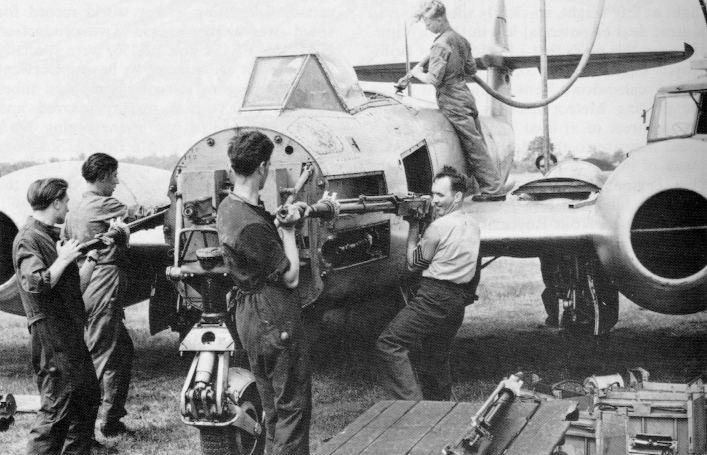
Five people at work in one picture: There can be no doubt that this was
posed. But it does show how the four Hispano cannon were installed in
the nose of a Meteor.
[4]
The armament of the first jet fighters was the same as that of the
last piston-engine fighters. There was only a change in armament
installation: Most jet fighters had their guns in the nose. Installing
guns in the nose instead of the wings gave concentrated fire at a wide
range of distances. The nose also offered more room than the wings,
which were being made thinner to reach higher speeds. And putting the
guns in front helped to balance the weight of the jet engine in the
tail. A problem, especially for night operations, is the muzzle flash,
that might blind the pilot temporarily.
While Germany of course did not design post-war military aircraft, it
is interesting to have a look at the designs that were on the drawing
boards in 1945. These were eagerly studied by the victorious allies, and
inspired many post-war aircraft. The Luftwaffe initially demanded that
the replacement of the Me 262 would be a high-altitude jet fighter
capable of 1000km/h between 7000m and 9000m, and with an endurance of 60
minutes at full throttle. The pilot had to be put in a pressure cabin,
with sufficient armour to stop .50 ammunition. Initially, the Luftwaffe
was satisfied with two 30mm MK 108 cannon.
But it quickly upgraded its demands to four MK 108 cannon, and two hours
endurance. The proposals were all swept-wing jet fighters. Alternatives
to the four MK 108 cannon proposed by the designers included two
MK 103 and two MG
151/20 cannon, or two MG 213C
revolver cannon.
The MG 213C was designed in 1944, and it was a revolver gun with a
five-chamber cylinder. By dividing the loading of a cartridge in three
steps, a high rate of fire could be achieved while keeping the forces
within the gun limited. There were 20mm and 30mm versions. The MG 213C
made linear action guns obsolete for fighters, and was copied
widely.
| Revolver Guns
|
|---|
| Name | Ammunition | Rate of Fire | Muzzle velocity | Weight | Q-factor
|
|---|
| MG 213C/20 | 20 x 135 ( 112 g) | 1400 rpm | 1050 m/s | 75 kg | 19200
| | MG 213C/30 | 30 x 85B ( 330 g) | 1200 rpm | 530 m/s | 75 kg | 12400
| | BK 27 | 27 x 145 B ( 260 g) | 1700 rpm | 1025 m/s | 100 kg | 38700
| | Aden Mk.4 | 30 x 113 ( 220 g) | 1300 rpm | 790 m/s | 87 kg | 17100
| | Aden 25 | 25 x 137 ( 180 g) | 1750 rpm | 1050 m/s | 92 kg | 31500
| | KCA | 30 x 173 ( 360 g) | 1350 rpm | 1030 m/s | 136 kg | 31600
| | DEFA 554 | 30 x 113 ( 275 g) | 1800 rpm | 820 m/s | 80 kg | 34700
| | GIAT 30M791 | 30 x 150 ( 275 g) | 2500 rpm | 1025 m/s | 110 kg | 54700
| | M39 | 20 x 102 ( 101 g) | 1700 rpm | 1030 m/s | 81 kg | 18700
|
 Aircraft Cannon Data.
Russian Aviation Gunnery Page.
IZMASH Page.
In Britain the armament of four 20mm Hispano cannon remained the standard. The Meteor
had actually been designed for six such cannon, but the mount of two of
them was too unpractical to be safely used. Four 20mm cannon were
carried by the last piston-engined fighters and the straight-wing jet
fighters. The Hispano remained in use until the first swept-wing
fighters appeared with the 30mm Aden
cannon, a copy of the MG 213C. With four Aden guns, the Hawker Hunter
was considered over-gunned by many observers: A rare distinction for any
fighter aircraft. Two Aden guns, as in the Lightning, Jaguar, Saab J35
Draken, and Folland Gnat, was a more common armament.
The evolution in France was almost identical to that in Britain,
except that the Hispano was not replaced by the Aden but by the
DEFA, a French derivative of the MG 213C. The
Aden and DEFA guns initially used slightly different ammunition, but
later common ammunition was introduced, creating a de facto standard for
30mm rounds. Because of the successful export of French aircraft,
the DEFA gun is still used world-wide. The later developments had an
increased rate of fire (up to 1800 rpm) and are fitted to modern
fighters such as the Mirage 2000.
Sweden adopted the Swiss 30mm Oerlikon KCA, a very powerful revolver cannon, for the
Saab JA 37 Viggen interceptor. It is relatively slow-firing, but has
excellent ballistics and it has been estimated that its ammunition has
twice the destructive power of the Aden/DEFA ammunition of the same
calibre.
The US Navy initially followed the British example. This had already
begun during the war, with types such as the F4U-1C and F8F-1B. Its
first jet fighters almost all had four 20mm Hispano cannon, for example the FH Phantom, F2H
Banshee, and F9F Panther. The M3 version of this gun was boosted to
850rpm. Like the Hispano Mk.V, it had been lightened by shortening the
barrel, in this case by 15in. The USN was unusual in that it continued
the use of these weapons on swept-wing fighters and right into the
supersonic age, although in an upgraded version: The Colt Mk.12. The Mk.12 fired a lighter projectile
with a larger charge. But on the Navy's Mach 2 fighter, the Vought F8U
Crusader, the Colt guns were an anachronism. They had a good rate of
fire and a high muzzle velocity, but were inaccurate, unreliable, and
unpopular. But the F8U at least had guns, and they contributed to the
good reputation that this fighter acquired in Vietnam. No gun was
installed on the F-4 Phantom II, in the belief that the new guided
missiles made gun obsolete. And the weight, bulk and vulnerability of
the electronics required for their use made it attractive to save weight
by leaving the guns out. Experience in Vietnam indicated that it was
still highly desirable to have a gun, and currently USN fighters are
equipped with the six-barrel M61
Vulcan.
| Linear Action Guns
|
|---|
| Name | Ammunition | Rate of Fire | Muzzle velocity | Weight | Q-factor
|
|---|
| Colt Mk.12 | 20 x 110 ( 110 g) | 1000 rpm | 1010 m/s | 46 kg | 20300
| | AM-23 | 23 x 115 ( 200 g) | 950 rpm | 690 m/s | 39 kg | 19300
| | NS-23 | 23 x 115 ( 200 g) | 550 rpm | 690 m/s | 37 kg | 11800
| | NR-23 | 23 x 115 ( 200 g) | 950 rpm | 690 m/s | 39 kg | 19300
| | NR-30 | 30 x 155B ( 410 g) | 900 rpm | 780 m/s | 66 kg | 28300
| | N-37 | 37 x 155 ( 755 g) | 400 rpm | 690 m/s | 103 kg | 11600
| | GSh-30-1 | 30 x 165 ( 400 g) | 1800 rpm | 890 m/s | 46 kg | 103000
|
Russian Aviation Gunnery Page.
IZMASH Page.
Aircraft Cannon Data.
The USAF was even more conservative. In the late 1940s the
standard armament of USAF fighters, with only few exceptions, was
still six Browning .50 M3 guns. It
was faster-firing than the M2 version used in WWII, but
experience in Korea demonstrated that this armament was painfully
insufficient. A report by Colonel Eagleston estimated that two
thirds of all MiG-15s hit with the .50 guns escaped. On the
other side it was observed that MiG-15s with 40 or 50 hits
routinely returned home. The American pilots still held the
advantage, because of better training, better gunsights, and
generally better equipment.
In some nightfighters and fighter-bombers the USAF installed
the 20mm M24 cannon, a version of
the Hispano M3 of the US Navy, modified to use electrically
primed ammunition. The first versions of the F-89 Scorpion, for
example, carried six of these guns. The F-86K carried four.
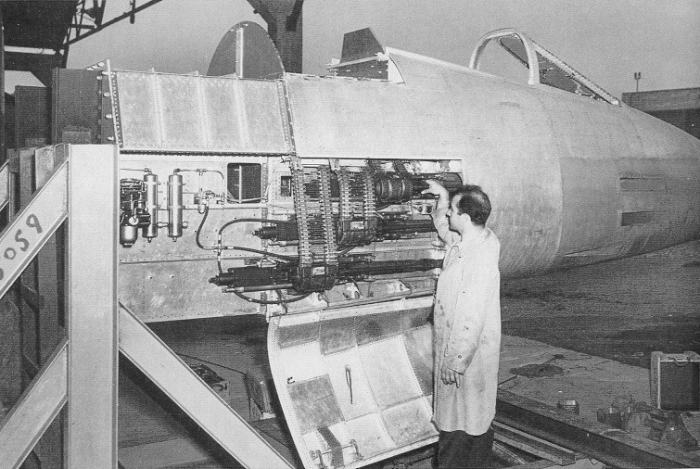
Left, for testing six M24 Hispano cannon were installed
in a mock-up of the nose of the XF-88.
[12]
A much-needed improvement was the Pontiac M39, a 20mm revolver cannon
broadly based on the MG 213C, but almost entirely redesigned.
This far better weapon was installed on fighters such as the
F-86H Sabre, F-100 Super Sabre, and Northrop F-5. A switch to
30mm cannon was considered, but rejected in the belief that
guided missiles would soon make the cannon obsolete. Apparently,
two F-89C protototypes were the only US fighters that ever
carried 30mm cannon.
The F-4 and F-106 appeared without cannon, but like the USN
the USAF had to change its mind because of combat experience, and
during the Vietnam war cannon were installed in these fighters.
The standard weapon became the six-barrel M61 Vulcan, and it is still in use today,
usually in its M61A1 form. The M61 was the first rotary
cannon, generally (and not entirely correct) called a Gatling
gun. Such weapons are reliable and offer a very high rate of
fire, and by dividing the firing over several barrels their wear
is reduced. Of course such guns weigh more than single-barrel
weapons. Characteristic of the M61A1, and most US rotary cannon,
is the beltless feed mechanism: Rounds are transported on a kind
of conveyer belt system, and empty cases are transported back
into the drum. The original M61 had a belt feed, but this could
not take the strain of firing rates higher than 4000 rpm.
An objection raised against rotary cannon is that the spin-up
time is fairly long: It takes 0.4 sec before the M61A1 spins up
to its nominal rate of fire, while a revolver gun reaches its
nominal rate of fire after 0.05 sec. Hence the advantage of the
rotary cannon is minimal or non-existent during a short
burst.
| Rotary Guns
|
|---|
| Name | Ammunition | Rate of Fire | Muzzle velocity | Weight | Q-factor
|
|---|
| M61A1 | 20 x 102 ( 101 g) | 6600 rpm | 1035 m/s | 120 kg | 49600
| | GSh-6-23 | 23 x 115 ( 200 g) | 8000 rpm | 740 m/s | 76 kg | 96100
| | GSh-6-30 | 30 x 165 ( 400 g) | 5400 rpm | 850 m/s | 145 kg | 89700
|
Description of the M61 on 3-4-9, the F-16 reference page.
The USAF museum has an M61 Vulcan.
Russian Aviation Gunnery Page.
Aircraft Cannon Data.
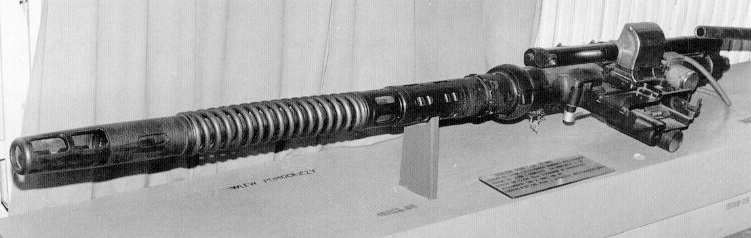
Left, the N-37.
[13]
The Soviet Union was more reluctant to abandon its guns, and it
indeed developed a surprisingly large number of new ones in the post-war
years. Apparently the USSR was reluctant to copy the MG 213C. It did
show a preference for large-calibre weapons, with calibres up to 57mm
proposed for installation in fighters. In these early years of the Cold
War only the USA had nuclear weapons, and the only means to deliver
these bombs was the B-29 or B-50 bomber. Hence Soviet fighters were
given armament sufficiently powerful to shoot down B-29s. The first
Soviet jet fighter, the MiG-9, was designed for two 23mm NS-23 cannon and one 57mm N-57, but the latter was replaced by the less
ponderous 37mm N-37 before the aircraft
flew. This was essentially a lighter, less powerful development of the
NS-37. Soviet designers estimated that it would take eight 23mm shells,
or two 37mm shells, to destroy a B-29. The same armament was retained by
the MiG-15, except that the NS-23 was soon replaced by the faster-firing
NR-23. In Korea it was shown that this
armament, though powerful, was stuck in a fighter that was a poor gun
platform and had primitive gunsight. However, the much-improved MiG-17,
with the same armament, was very effective in Vietnam.
The supersonic MiG-19 abandoned the N-37. Initial deliveries had two
NR-23 cannon, but the standard weapon was the NR-30, basically a scaled-up NR-23. But for its
first generation of Mach 2 fighters, the Su-9 and MiG-21, the USSR too
abandoned guns. On all-round fighters they soon returned. The
twin-barrel GSh-23 guns were installed on
the MiG-21 and the MiG-23. This weapon uses the Gast principle, named
after its inventor Carl Gast, who developed it in Germany during WWI. In
these guns, the firing of one barrel drives the action of the other half
of the gun.
| Gast Guns
|
|---|
| Name | Ammunition | Rate of Fire | Muzzle velocity | Weight | Q-factor
|
|---|
| GSh-23L | 23 x 115 ( 200 g) | 3400 rpm | 740 m/s | 72 kg | 43100
|
Modern Fighter Guns
The choice for modern fighters is generally between revolver guns and
rotary guns. The former are lighter and fire more rounds in a short
burst, the latter have a higher sustained rate of fire.
In Britain a new version of the Aden was developed, the
Aden 25, that fires the NATO standard 25mm
ammunition. This has been adopted for the latest British versions of the
Harrier, two being installed in underfuselage packs. US versions of the
same aircraft fire the same ammunition, but they have a single rotary
gun, the five-barrel GAU-12 Equaliser.
But for the RAF's next generation fighter, the gun is provided by
Germany. For European aircraft projects, including the Tornado and the
Eurofighter, the Mauser BK 27 was
developed. This 27mm revolver cannon is a new design. No attempt was
made to use existing ammunition, and the 27mm calibre is unique. The BK
27 was also adopted for the Swedish JAS 39 Gripen. It has been
considered to develop a multi-barrel version of this gun for
Eurofighter, but this plan seems to have been abandoned.
The French stepped out of the Eurofighter project. Their
next-generation fighter is the Rafale, and a new gun has been developed
for it: The GIAT 30/791. This is one of the
fastest-firing single-barrel guns, thanks to the use of a seven-chamber
cylinder.
Current Soviet fighters are armed with the six-barrel GSh-6-23 and GSh-6-30, or with the single-barrel GSh-30-1. The MiG-31 has the very
fast-firing GSh-6-23. This is probably the fastest-firing gun in
use, and the manufacturer claims rates of fire as high as 10000
to 12000 rpm for this gun! The GSh-6-30 was used on the MiG-27,
for ground support missions. But apparently the GSh-30-1 is
preferred for the MiG-29 and Su-27 because of its greater
destructive power and lower weight. The GSh-30-1 is unique,
because it is the only linear action gun used in a modern
fighter. Its rate of fire is similar to that of a revolver
cannon, and the GSh-30-1 is considerably lighter. And while its
muzzle velocity is modest by modern standards, its accuracy is
reported to be very good.
The USAF and USN again show conservatism. Development of the new 25mm
GAU-7 gun using caseless ammunition was abandoned, and the old M61 is
still the main fighter gun. Some effort has been made to reduce the
weight of the gun, and a version weighing 93kg is under development.
This also decreases spin-up time. The disadvantage of the M61 is now the
relatively small killing power of its ammunition: Other nations have now
adopted larger calibre guns, that fire rounds two or three times heavier
than the M50 ammunition of the Vulcan. These 20mm rounds are still the
same size as that adopted for the M39s in the 1950s, and at time deemed
acceptable in the belief that guns would soon become obsolete!
The table below gives the firepower parameters of some modern
fighters. Note that the apparent advantage of rotary guns in rate
of fire would decrease if short bursts are fired, because of their
longer spin-up time. Data for the number of rounds fired in the
first second by the M61A1 vary from 47 to 72.
| Fighters | Guns | Rounds/sec | Weight/sec
|
|---|
| MiG-31 | 1 x GSh-6-23 | 133.3 | 26.7 kg/sec
| | Su-27, MiG-29 | 1 x GSh-30-1 | 30.0 | 12.0 ks/sec
| | Rafale C | 1 x 30M791 | 41.7 | 11.5 kg/sec
| | F-14, F-15, F-16, F-18 | 1 x M61 | 110.0 | 11.1 kg/sec
| | Mirage 2000 | 2 x DEFA 554 | 30.0 | 8.3 kg/sec
| | JA 37 Viggen | 1 x KCA | 22.5 | 8.1 kg/sec
| | Eurofighter, JAS 39 Gripen | 1 x BK 27 | 28.0 | 7.4 kg/sec
|
This can be compared with the data for WWII
Fighters. At the end of WWII, the best fighters had an armament
firing about 5kg/sec. All modern fighters are well above that, but the
difference is smaller than one would expect. The reason is the decreased
importance attached to guns in modern air combat, as missiles are now
the primary weapon. The is less pressure to improve firepower than there
used to be. This is particularly obvious for US fighters: If only the
guns are taken into account, the F-22 will have slightly less firepower
than the F-100 Super Sabre!
Next: Korean War Fighters
© 1998-1999
Emmanuel Gustin
gustin@uia.ua.ac.be
This page hosted by 
Get your own Free Home Page
|
