Upward firing guns
A word-by-word translation of the German term Schräge Musik, would be slanted
music, but it actually means jazz. It is more known, however,
as the name for an arrangement of upward-firing guns, installed in
German nightfighters and used with great effect against British night
bombers. There was some irony in the choice of this name, because jazz
was officially forbidden in Nazi Germany, rejected as a "degenerate" art.
The First World War
There was nothing new about upward-firing guns. They first appeared
during WWI, because the dominant type of aircraft, for all roles except
that of fighter and long-range bomber, was a two-seat biplane with a
tractor engine. In its more developed form the observer-gunner sat
behind the pilot, armed with a flexible Lewis or Parabellum machinegun.
He could defend the aircraft against attacks from the upper hemisphere,
but was powerless against attacks from the rear and below. This could be
exploited by interceptors, but an attack from below either required a
climbing attack, which could not be maintained for long, or some
form of upward-firing armament.
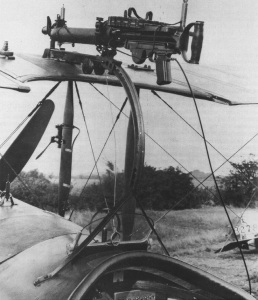
Left, a Lewis gun on a Foster mount. The aircraft is
an SE.5a. Note the two posts for a ring-and-bead gunsight on
top of the gun, used to fire it upwards.
[4]
Before the introduction of gun synchronisation mechanisms some
single-seat biplanes had been equipped with a fixed machinegun, usually
a Lewis, on the center section of the upper wing, so that it could shoot
over the propellor. The best known of these fighters was the Nieuport 11 Bébé. To allow
the pilot to change ammunition drums, the Foster
mount was developed: A curved rail, that made it possible to
slide the gun backwards and downwards. In the latter position, the gun
pointed upwards, and could be used for attacks from below. This was its
only real advantage. Disadvantages were many: It caused drag, changing
the ammunition drums was very difficult, and its recoil disturbed the
aim. Nevertheless, the success that pilots such as Albert Ball had with
the Foster mount explains its presence on the later Royal Aircraft Factory SE.5a, at a time
when most fighter aircraft had two synchronized guns.
Some German pilots experimented with Foster mounts that had been
captured. At the time, it was not unusual for pilots to order
considerable modifications to their aircraft. But this seems to have had
no influence on later German practice.
The Lewis guns on the upper wing also appeared on the Sopwith Dolphin and, interestingly, on
Sopwith Camel fighters modified for
nightfighting. In the latter case, however, the main purpose was to
improve the forward view of the pilot by removing the Vickers guns in
front of him. After the end of WWI most fighters had twin synchronized
guns, even nightfighters.
Interbellum Experiments
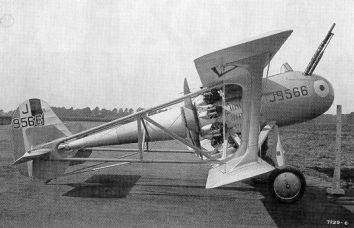
Left, the Vickers model 161 was built to specification
F.29/27. It was an obvious dead end. The prototype flew
little and reportedly fired only 24 shells.
[62]
During the interbellum upward-firing guns were tried on a number of
British aircraft. This was called the no-allowance method of gunsighting, because the
idea was that the attacker would fly in close formation with the target,
slightly below it, so that no allowance had to be made for relative
speed. Specification F.29/27 called for a single-engined, single-seat
fighter armed with a 1½lb COW gun, angled upwards. Development of
this weapon, by the Coventry Ordance Works, had continued since before
WWI. At 97kg, it was relatively light for a weapon of this size. It
fired 37x190 ammunition at a rate of 1.5 per second, fed from five-round
clips, and had already been used on a handful of aircraft during WWI.
Unfortunately, the two F.29/27 fighters were both disappointing. The
Vickers F.29/27 was a pusher
biplane, an obsolescent design with a bewildering array of struts and
bracing wires. The Westland F.29/27
was a low-wing monoplane and looked much better, but had completely
unacceptable handling characteristics.
More promising were experiments with the standard .303 Vickers and
Lewis guns. In 1927 the Boulton-Paul
Bittern made its first flight, a nightfighter built to
specification F.27/24. The second prototype of the Bittern had
vertically swivelling Lewis guns machineguns on the side of its nose, so
that they could be set at an angle between 0 and 45 degrees. A
ring-and-bead gunsight was to be mounted on a frame, which could be set
at the same angle. But the underpowered Bittern never entered
service.
A simpler approach was represented by two Bristol Bulldog biplane fighters, that
were modified in 1934 with Lewis or Vickers guns mounted at the side of
the cockpit, at an angle of 60 degrees up. During tests, the
installation demonstrated great accuracy: Flying 100ft below their
targets, the fighters scored 90% hits. However, the armament of two
rifle-calibre machineguns was too weak.
One interesting aircraft, flown just before the beginning of WWII,
must also be mentioned. The prototype of the Gloster F.9/37 twin-engined monoplane
fighter was armed with five 20mm Hispano cannon, angled up 12 degrees.
This angle was determined by practical considerations: Three of the guns
were behind the cockpit, in the space originally allocated for a gun
turret. They had to be angled up to clear the cockpit. It is not clear
what attack mode was envisaged for this aircraft.
Schräge Musik
One of the first effective British nightfighters was the Boulton-Paul Defiant. The Defiant, armed
with four .303 guns in a powered turret, had failed as a day fighter.
Its natural approach as a nightfighter was to attack from below, because
the guns in the turret could not fire straight forward. But the career
of the Defiant as a nightfighter was fairly short, and apparently it
made no impression on the Germans. Effectiveness was certainly limited,
because of the light firepower and the blinding muzzle flash.
Shortly before the war, the idea of upward-firing guns for
nightfighters had reached the Luftwaffe from several sources. A
Leutnant Tiede, who had used upward-firing guns in WWI,
approached the Reichsluftfahrtsministerium with his design, but
it was rejected. Reports of Japanese experiments conducted in 1938 and
1939 were received, but apparently these too failed to make an
impression. After the outbreak of war, there were several incidents
in which observer guns were aimed at the belly of British bombers,
but usually these were only 7.92mm weapons.
Apparently the instigator of the adoption of Schräge Musik by the Luftwaffe was
Oberleutnant Rudolf Schönert, who started advocating this in 1941.
The first installation was made late in 1942, in a Do 17Z-10 that was
also equipped with Lichtenstein radar. The
results were inconclusive, and development was shelved for a year.
Nevertheless it is reported that in the summer of 1942 Schönert,
then commanding II/NJG 5, received three Do 217J nightfighters for
operational testing of this form of armament. (Schönert had his
first combat success with Schräge Musik in May 1943, and then not
in a Do 217J but in a field-modified Bf 110.) Wide-scale adoption
followed in late 1943, and in 1944 a third of all German nightfighters
carried upward-firing guns.
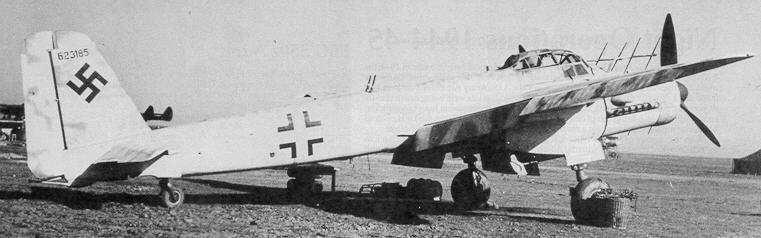
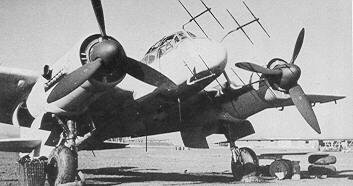
Above and left. One of the most effective German nightfighters was
the Ju 88. This is a Ju 88G-6 with liquid-cooled Jumo 213 engines,
Lichtenstein SN radar, and two Schräge Musik
MG 151/20 cannon installed in the aft fuselage.
[28]
There was more to Schräge Musik than just fitting a few
angled-up cannon, usually MG 151/20 or MK 108. These were put
in the rear of the cockpit of the Bf 110, in the aft fuselage of the He
219, and behind the cockpit of the Ju 88 and Do 217. It was important to
attack undetected, and therefore tracers were not used. Special
ammunition with a faint glowing trail replaced them. The guns were given
flash reducers. An additional gunsight was installed in the cockpit to
aim the guns. The attack from below had the advantage that the
nightfighter crew could observe and identify the silhouette of the
aircraft before they attacked. At the same time the bomber crew could
not see the nightfighter against the dark ground, nor defend itself: The
belly turrets of British bombers had been removed because of their
limited effectiveness and to reduce drag. The nightfighter usually aimed
for the fuel tanks, not for the fuselage, because of the risk that
exploding bombs would damage the attacker. Schräge Musik soon
produced devastating results. It was at its most successful in the
winter of 1943-1944. This was a time when losses became unacceptable:
The RAF lost 78 of 823 the bombers that attacked Leipzig on 19 February,
and 107 of the 795 bombers that attacked Berlin on 30 March.
RAF Bomber command compensated for the German lateness to adopt this
form of armament by reacting slowly to it. Reports of bomber crews gave
no indication, because the German nightfighters managed to stalk their
preys without being perceived. Only an analysis of the damage done to
returning bombers demonstrated that the Germans were firing from below.
This seems to have been understood fairly quick, for the problem was
already reported in April 1943. However, it took considerable time to
implement a satisfactory solution. Initially, a downward observation
window was provided, and Canadian bombers again received belly turrets.
But the effectiveness of these measures was small, because the attackers
were very hard to see. Radar was a better solution, but the Monica tail-warning radar provided warning only
if the attacker approached from astern, not from below. Anyway, in July
1944 the British discovered FuG 227
Flensburg in a captured German aircraft, a receiver that could be
used to home in very accurately on the emissions of the Monica radar
from a distance of 80km. The tail-warning radar then had to be
deleted.
The H2S navigation radar,
that had replaced the belly turret on many bombers, did look downwards;
but it did not provide any warning of enemy aircraft approaching from
below. The H2S display showed the radar image starting from
the first ground return, so that a map could be drawn. Any echoes
preceding this ground return were discarded -- The echoes of aircraft
below the bomber. A modification of a H2S radar proceeded as
soon as the developers became aware of the problem, and to avoid
administrative delay, development was undertaken more or less
clandestinely. In July 1943 the Fishpond
modification of H2S was ready. A display screen was added,
that indicated range and bearing of any aircraft below the bomber; an
estimate of the relative height could be made by banking the bomber. But
Bomber Command was large, and it took considerable time to install the
new equipment. By the spring of 1944 most bombers carried Fishpond, and
losses dropped sharply. However, there was considerable turmoil when it
was discovered that German nightfighters carried the Naxos detector, that allowed them to determine
the origin of H2S emissions. Only after the interrogation of
prisoners made clear that Naxos was far too inaccurate to allow
nightfighters to home in on an individual bomber, and at best gave an
indication of the position of the bomber stream, was confidence in
H2S and Fishpond restored.
An outgrowth of the Schräge Musik concept was the development of
a number of vertically firing Sondergeräte, a term which can be translated
as "special devices". These consisted of a number of recoilless
single-shot guns, firing 30mm or 55mm ammunition. They were triggered by
photo-sensitive cell. In theory, all the pilot had to do was pass at a
suitable distance (100m to 50m) under a bomber. Use of these weapons
remained experimental, and after the war nobody continued the
concept.
Next: Big Guns
© 1998-1999
Emmanuel Gustin
gustin@uia.ua.ac.be
visitors since 23 December 1998.
This page hosted by 
Get your own Free Home Page
|