Big Guns
Cannon with a calibre of 37mm and more have never become popular as
aircraft weapons, despite many attempts to adopt them, both for air-to-air
combat and for air-to-surface combat. Currently they are very rare. The
main attraction of such weapons has always been the possibility of a
single-shot kill of a large bomber, a small ship, or a tank. The
disadvantages of these weapons are excessive weight, limited ammunition
supply and low rate of fire. Recoil is also a significant problem, but in
theory this is one that can be avoided by the development of recoilless
guns. However, no recoilless gun has ever been really successful.
Early Experiments
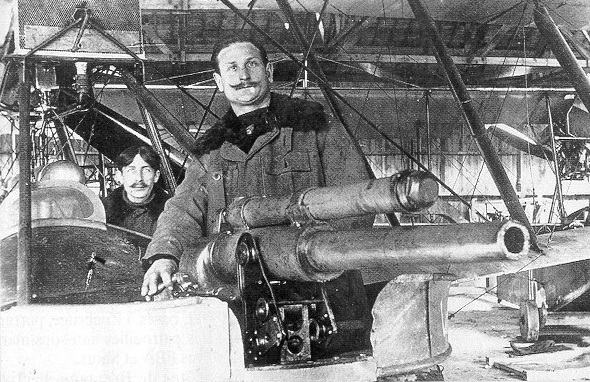
Left, Hotchkiss 47mm cannon in the nose of a French
Tellier flying boat.
[54]
Among the earliest cannon fired from aircraft were the Hotchkiss weapons of calibre 37mm and 47mm,
weapons constructed with parts of the automatic cannon of the period.
The 37mm was produced in significant numbers, and available in version
with a long and a short barrel. A few hundred French aircraft were
equipped with them during WWII; mostly on the Breguet 5 and the Voisin
4, both single-engined aircraft of pusher configuration. Because
they were loaded manually, the rate of fire was very low; and they were
not very effective in air-to-air combat. They were useful as ground
attack weapons, however.
The French identified another possible use for large cannon: As
anti-submarine weapons. During WWI aircraft were slow enough that a
spotted submarine might be able to dive before the aircraft could drop
bombs on it. A cannon extended the reach of the anti-submarine aircraft.
This culminated in the concept of a "high seas flying boat", for which a
specification was written in 1918. This would be an aircraft with a crew
of four, an eight-hours endurance, and an armament including two
machineguns, 120kg of bombs, and a 75mm cannon with 30 rounds! The
aircraft designed to this specification never entered service, but the
Tellier T.7 did serve as testbed for the
75mm cannon between 1920 and 1922.
In Britain too, experiments were conducted with a number of
large-calibre weapons, mainly for use against balloons and airships,
although they were also used for ground attack. Vickers delivered the
Vickers 1½-pounder and 1-pounder guns, the 1.59in Vickers Crayford, also known as the "Rocket Gun"
because its incendiary projectile left a trail of sparks, and the Vickers 1-inch gun. The automatic 1-pounder
cannon, basically a much enlarged Maxim machinegun, was the most
successful, but nevertheless remained rare. Its recoil was the largest
disadvantage.
More common than the Vickers guns was a weapon developed by the
Coventry Ordnance Works, the 37mm 1½-pounder COW gun. The COW gun was
automatic, very light for a weapon of this calibre, and had a good
ballistic performance. But nevertheless it was a bulky weapon, and it
saw little service. During the the interbellum it was carried by a few
large aircraft, and a handful of fighters were designed round it, but
none of these installations was adopted by the armed forces. The weapon
seems to have seen its only actual service on the ground, as
anti-aircraft gun...
Cleland Davis designed the recoilless
guns named after him. They were simple weapons, basically a barrel with
two open ends; the recoil was compensated by firing a lead shot
rearwards. The loading procedure required the barrel to be made in fore
and aft pieces, joined at the center, so that the round could be
inserted manually. Leaks at this joint were a serious design problem.
Three versions were produced, a 2-pounder, a 6-pounder and a 12-pounder.
Its service life, mainly as anti-Zeppelin weapon, was short. The lead
shot fired from the rear, and the rearwards blast, made this weapon
highly inconvenient to install in the fragile WWI aircraft. It
was installed on some aircraft, but generated little enthusiasm
among the crews who had to use it.
One of the first aircraft designed for a really large cannon was
the Admiralty Type 1000, also known as the
AD.1. The Admiralty's concern was the German
fleet, and it planned three versions: A bomber, a torpedo bomber capable
of carrying an 18 inch torpedo, and a gun machine armed with a
recoilless Davis 12-pounder gun. The latter
would be used to lob shells at small warships from a safe distance.
Development of the giant seaplane began in 1915, and it was completed and
flown in the summer of 1916. Concerns about the rearwards blast of the
Davis gun caused to design to be changed for a 12-pounder Naval Landing Gun, a conventional
cannon, that would be installed on a mount allowing 49 degrees elevation
and 38 degress depression. In the end, no gun was ever installed in the
AD.1.
Soviet Recoilless Guns
The recoilless Davis guns inspired the development by B.S. Stechkin and
L.V. Kurchyevskii of a series of similar weapons in the USSR. Between 1930
and 1936, when he was arrested and disappeared, Kurchyevskii developed a
series of guns, that were installed in experimental and even production
fighters. The design of all these aircraft was influenced by the rearwards
firing of a compensating mass. Either the guns had to be in the wings, or
the barrel had to be extended to the extreme tail of the aircraft.
Project Z, also called TsKB-7, was a small low-wing monoplane fighter
developed by Grigorovich. He used parts of the I-5 biplane fighter to
speed development. The aircraft had a recoilless 76.2mm DRP under each wing, and a single 7.62mm PV-1
machinegun in the fuselage to assist in aiming. About 50 production
aircraft, called I-Z, were built. But because
they suffered from handling problems, and the DRP guns were single-shot
weapons, they were mostly used for further development work. Grigorovich
followed with the IP-1, a refined aircraft
armed with APK-4 guns at the wingtips. These
could fire five rounds. Although the IP-1 entered production, it was
without the recoilless guns: The 20mm ShVAK
was preferred. The IP-4, with four 45mm APK-11 guns, remained experimental. Later
Grigorovich fighters still had heavy armament, but significantly, stuck
with multiple conventional 20mm cannon.
Meanwhile, work had also been underway in Tupolev's design bureau. The
ANT-23 had a highly original concept: The
crew and the two engines, one tractor and one pusher, were installed in a
small nacelle. The long barrels of the recoilless APK-4 guns actually formed the tail booms. However,
when a shell exploded in one of the guns the ANT-23 barely landed safely,
and the aircraft was abandoned. More promising was the ANT-29. This was a conventional, highly streamlined
twin-engined monoplane, with a single 102mm DRP or two APK-8 in
the fuselage. The ANT-46, a basically similar
design, instead had two APK-11 guns in the
wings, and apparently the design goal was to use the 100mm APK-100. But the arrest of Tupolev and the
disappearance of Kurchyevskii ended the development of fighters with
recoilless guns.
Tank Busters
The interest in large aircraft cannon was revived during WWII by the
steady increase in the armour thickness of tanks. Most air forces
discovered the need for dedicated anti-tank weapons for attack aircraft.
However, experience on the battlefield showed that this was not always the
best solution: Tanks were well protected against anything but a direct
hit, and that was difficult to achieve. Soft-skinned supply vehicles or
horse-drawn artillery where much more rewarding targets, but the power of
a heavy cannon was wasted on them.
In the USSR, S.V. Ilyushin managed to convince the Politburo of the
need for a modern, heavily armoured ground-attack aircraft. The first
prototype of the Il-2 Shturmovik flew
in 1939. With 990kg of armour, the Il-2 was always a modest performer and
highly vulnerable to fighter attack, but it was well-protected against
small arms fire from the ground. The Il-2 was, according to Stalin, as
essential for the Red Army as bread, and about 36000 were built. This made
it the world's most built aircraft, but such production figures were
necessary to compensate for the heavy losses. Instead of large cannon, the
Il-2 relied on high-velocity guns of small calibre. The initial armament
of 20mm ShVAK cannon was insufficient, but
they soon replaced by the powerful 23mm VYa.
Only in 1943 a number were equipped with the 37mm NS-37. These were considered effective enough
against the German tanks, because the rear and top armour was much thinner
than the front armour.
P.O. Sukhoi, with his Su-6, had unsuccessfully competed with the Il-2:
Although the Su-6 was a better aircraft, it was decided not to halt
production of the Il-2. This did not deter him, and in 1942 he got
approval for a long-range attack aircraft to complement the short-ranged
Il-2. The Su-8 was a sleek, powerful,
twin-engined aircraft, again with a heavily armoured cockpit. It could be
armed with either four 37mm 11P-37 cannon, or
two 45mm OKB-16-45 cannon. The latter were
fed by clips. To assist in aiming, four 7.62mm ShKAS guns were installed in the wings. The Su-8
would have had the heaviest forward-firing armament of any WWII aircraft,
but it was not put in production, because the war was nearly won. The line
of thinking behind the Su-8 was continued with a series of anti-armour
derivatives of the excellent Tu-2 twin-engined bomber. The second
prototype of the Tu-2Sh carried a 75mm
cannon, and the third carried two 20mm ShVAK
cannon, two 37mm NS-37 and two 45mm NS-45. The Tu-2RShR
had a 57mm RShR cannon installed in the lower
fuselage. All these aircraft remained prototypes.
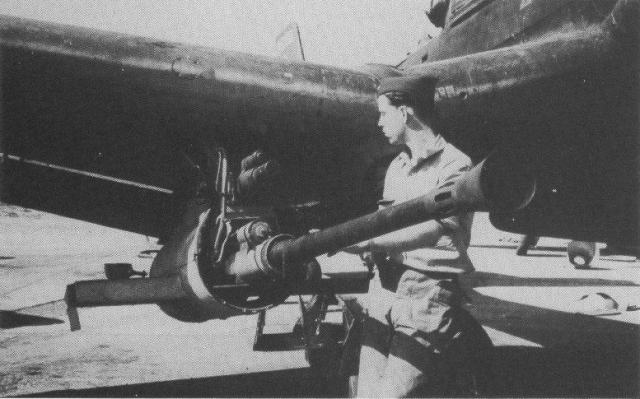
Left, The BK 3,7 cannon under the wing of a Ju 87G, the
anti-tank version of the famous Stuka.
[16]
Initially, the Germans also opted for high-velocity cannon, but they
did not have a direct equivalent of the VYa. Instead, the Junkers Ju 87G anti-tank aircraft appeared with two
BK 3,7 cannon in pods under the wings, with
six rounds each. The BK 3,7 was a 37mm weapon, developed from the Flak 18
anti-aircraft cannon. This armament installation proved highly successful
against Soviet armour, despite the vulnerability of the obsolescent Ju 87
design. A purpose-designed attack aircraft was the Henschel Hs 129. As in the Il-2, the cockpit was an
armoured box. With two Gnome-Rhone 14M4/5 radials, captured French
engines, the Hs 129 was decidedly underpowered. It had a MG 17 and a MG
151/20 on each side of the fuselage, but the anti-tank cannon was carried
in a fairing under the belly. It could be the 30mm MK101 or MK103, but
also the BK 3,7. There were even experiments
with the mighty 75mm BK 7,5, in an attempt to
ensure the destruction of Soviet tanks, that carried increasingly heavy
armour. Such 75mm cannon, the KwK 39 and PAK 40, also appeared on the
Ju 88P, but their weight, recoil, and
enormous muzzle blast were too much even for this twin-engined bomber.
After the Ju 88P-1, later models switched to two BK 3,7 cannon, or one
BK 5, derived from the PAK 38.
The RAF and USAAF never had an armoured ground-attack aircraft similar
to the Il-2. Instead, they increasingly used fighter-bombers. Compared
with the Il-2, these were more vulnerable to small arms fire from the
ground, especially those with liquid-cooled engines, but on the other hand
they could defend themselves succesfully against enemy fighters, and in
general formed a force with superior range, speed, and flexibility. Both
approaches can be defended. The Germans seems to have considered the
Allied air superiority on the Western front more threathening, but then
the front in the East was much longer, and air support was spread
thinner.
Below, a table of anti-tank cannon carried by WWII aircraft. The
ammunition specified in this table is the AP round used for
anti-tank missions, which usually has a higher muzzle velocity
than other rounds developed for the same gun.
| Name | Ammunition | Rate of Fire | Muzzle velocity | Weight
|
|---|
| MK 101 | 30 x 184B (355 g) | 250 rpm | 960 m/s | 178 kg
| | MK 103 | 30 x 184B (355 g) | 420 rpm | 860 m/s | 146 kg
| | BK 3,7 | 37 x 263B (380 g) | 160 rpm | 1170 m/s | 295 kg
| | BK 5 | 50 x 419R (1250 g) | 50 rpm | 1200 m/s | 540 kg
| | BK 7,5 | 75 x (3300 g) | | 933 m/s | 1000 kg
| | VYa | 23 x 152B (200 g) | 500 rpm | 905 m/s | 69 kg
| | NS-37 | 37 x 195 (735 g) | 250 rpm | 900 m/s | 150 kg
| | Vickers S | 40 x 158SR (1130 g) | 100 rpm | 615 m/s | 134 kg
| | Moulins 6pdr | 57 x 441R (3170 g) | 60 rpm | 790 m/s | 816 kg
|
Fighter-bombers could still be armed with large guns, and the Hurricane Mk.IID was fitted with two 40mm Vickers S cannon in pods under the wing, with two
Browning .303 retained to assist in aiming. In the North African desert
it proved effective, but the type was abandoned because it was
vulnerable both to enemy fighters and to light AA guns, and its armament
was considered to be ineffective against the newest German tanks. An
alternative was the Mosquito Mk.XVIII with
an Molins 57mm cannon, but this cannon too
was rated unable to cope with the armour of a Tiger tank. The Mosquito
Mk.XVIII, nicknamed Tsetse, was instead sent to Coastal Command
for use against U-boats. The Allies switched to rockets as anti-tank
weapons, and did not consider cannon again.
Near the end of the war a new breed of attack aircraft started flying.
These were aircraft with the general configuration of light bombers, but a
performance closer to that of fighter-bombers. A good example was the
Beech A-38 Grizzly, a compact, clean aircraft
powered by two mighty R-3350 radial engines. The A-38 carried the powerful
T15E1 75mm cannon in the nose, with 20 rounds
of ammunition. Unfortunately for the A-38, all R-3350 engines were
required for the B-29 program.
Anti-ship installations
The Mosquito Mk.XVIII was not the only example of an attack aircraft
for anti-ship missions, armed with a big gun. The best known example are
variants of the B-25 Mitchell medium
bomber. The B-25G carried a 75mm M4 gun,
and the B-25H switched to the T13E1. The M4
was an army weapon, light and compact enough to be installed in the nose
of a B-25. The T13E1 was a lightened version, more adapted to aircraft
installations. The weapon was effective against small vessels, but
because it was manually loaded only a few rounds could be fired during
an attack. Near the end of the war suitable targets became scarce, and
the 75mm gun was often replaced by additional .50 machineguns.
A much more ambitious project was the Piaggo
P.108A. The P.108 was Italy's modern four-engined bomber, a neat
aircraft in the class of the B-17. Only a handful were built, and they
equipped the only strategic bomber squadron of the Regia
Aeronautica. The P.108A --- A for Artigliere --- carried a
naval 102mm cannon in the nose, angled slightly downwards. With the
recoil system, this gun weighed no less than 1500kg, and a generous 50
rounds of ammunition were provided, adding another ton to the installed
weight. Apart from the need for some local strengthening and the
compilation of new firing tables, the aircraft was considered a success.
Plans for production of series aircraft, and conversion of P.108B
bombers to P.108A configuration, were halted by the Italian
surrender.
Heavy Bomber Interceptors
For the use of heavy cannon against bombers two approaches were
possible. The cannon could be mounted fixed and aimed in the same way as
conventional fighter armament, or it could be made flexible, and aimed
either manually or by a powered system. The latter approach required a
rather large and heavy aircraft, but this was less of an objection for a
fighter armed with 37mm or even heavier cannon, because it was already
expected to be unwieldy. The perceived advantage was the greater
accuracy that could be achieved with sophisticated gunsights and
automatically aimed guns. This would make it practical to open fire from
a large distance, well outside the range of the defensive armament of
bombers. The effectiveness of the latter was generally overestimated
during the 1930s.
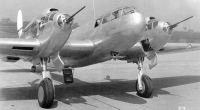
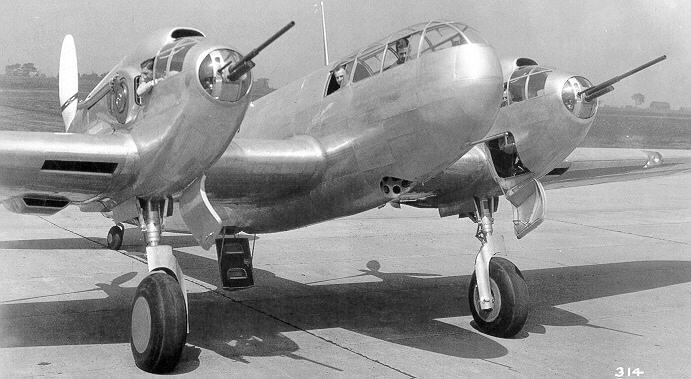
Left, the Bell FM-1 Airacuda was designed around two 37mm
M4 cannon in the engine nacelles and their gunnery control
system.
[26]
The most famous example of such a fighter is the Bell FM-1 Airacuda, a twin-engined aircraft first
flown in 1937. The FM-1 was a low-wing monoplane with pusher propellers,
driven by turbosupercharged Allison V-1710 engines. This arrangement
left room for a 37mm M4 cannon in the nose
of each engine nacelle, hydraulically controlled, with a coaxial
machinegun to assist in aiming. A gunner in the nose of the FM-1 used a
Sperry autopilot, a fire control system originally developed for
anti-aircraft cannon, and an optical sight to aim these weapons.
Impressive it was, but nobody could find a real need for it, or invent
the tactics for its use; and the FM-1 faded into obscurity. There were
attempts to revive the concept, for example the British Vickers 414, armed with a 40mm Vickers S cannon, but they remained paper
designs.
Bell had become enthusiast about the 37mm cannon, and it proposed
such armament for its new single-seat fighter, the P-39 Airacobra. This small fighter was also
intended as a high-altitude bomber interceptor. As initially designed it
had a turbosupercharged V-1710 engine, similar to those of the FM-1, but
the gun was installed fixed, in the nose. The engine was put behind the
pilot to make room for the gun, and drove a tractor propeller by a long
extension shaft. Deletion of the underdeveloped turbosupercharger
installation turned the P-39 into a mediocre medium-altitude fighter,
and in combat the M4 revealed its weaknesses of low firing rate and
modest ballistic performance. The weapon, in its improved M10 version,
was also retained by the later P-63
Kingcobra, with exception of one P-63D that had the far more
powerful M9. The USAAF had no use for these
fighters, and both the P-39 and P-63 were mainly produced for Lend-Lease
to the USSR, where they were surprisingly successful. The M4 continued
to feature in fighter designs, such as the McDonnell P-67, proposed with six such weapons in
the wing roots! But the only other fighters to enter service with the M4
were the first Lockheed P-38 Lightings, and
in this aircraft it soon gave way to the 20mm Hispano. This was a much more useful weapon for a
fighter.
Soviet enthusiasm for the P-39 and P-63 may be related to their own use
of 37mm and 45mm weapons in fighters. The Yak and LaGG fighters were
powered by the Klimov M-105, a Soviet development of the French
Hispano-Suiza 12Y. This engine was suitable for installation of a cannon
on the centreline, firing through the propeller hub. Initially this was
the 20mm ShVAK or the far more powerful 23mm
VYa, but soon heavier weapons were
considered. The initial choice was the 37mm Sh-37, installed in a small number of LaGG-3 and Yak-9T
fighters, but soon replaced by the competing NS-37. A small number of Yak-9TK and Yak-9K
aircraft received the NS-45, a
straightforward modification of the NS-37 to fire a larger shell. Later
the NS-37 was replaced by the lighter N-37.
That these weapons also could be carried by the final Yakovlev
piston-engined fighter, the Yak-9P, indicates
that they were considered a success. Yet their recoil was such that the
pilots were trained to fire three-round burst with the NS-37, and single
shots with the NS-45. They were also instructed to do so only at high
airspeeds. The pilots were carefully selected for their shooting ability,
and perhaps this contributed to the relatively high effectiveness of these
weapons. Experiments with the NS-57 in the
Yak-9 lead to the conclusion that the recoil of this weapon was really too
high, and it was not installed in production aircraft.
Heavy cannon could be carried more easily by heavier fighters,
especially twin-engined fighters. Although prototypes of twin-engined
fighters were built in the USSR, their production fighters were
single-engined and diminutive in size. Germany, on the other hand, built
a large number of twin-engined fighter aircraft, and equipped them with
heavy cannon in an attempt to combat the Allied heavy bombers. This
started with subtypes of the Messerchmitt Bf
110, the Bf 110G-2/R1 and Bf 110G-4a/R1, that carried the BK 3,7 cannon in a ventral gondola. The Me 410 was developed as a more powerful
replacement for the Bf 110, and in line with this the Me 410A-2/U4 and
Me 410B-2/U4 carried the 50mm BK 5. The
appearance of long-range escort fighters made both the Bf 110 and Me 410
far too vulnerable to operate in daylight, and removed this threat. An
alternative was the installation of 50mm cannon in the Me 262 jet fighter, and prototypes of this
aircraft with the BK 5 and the MK 214A were
produced. Development of a light, low-velocity 55mm cannon, the MK 112, was never completed. The Me 262 also
pioneered the use of the R4M rocket, an unguided air-to-air weapon.
Rockets had been used for air combat before, mainly by the Russians, but
it was the German development and successful use of the R4M that finally
doomed heavy cannon as fighter weapons. They were a far more efficient,
if less accurate, way to get a heavy warhead to the target.
The other nation to make widespread use of twin-engined fighters was,
remarkably enough, Japan. For the Army the Kawasaki Ki.45 and Ki.102 twin-engined fighters were developed, and
they were produced both in escort fighter, heavy fighter, ground attack,
and anti-shipping versions. They were equipped with a surprisingly wide
array of heavy cannon, including the 37mm Type
94, Ho-203, and Ho-204, the 40mm Ho-301, and the 57mm Ho-401. The 37mm Type 94 was also installed in a
the fighter derivative of the Mitsubishi
Ki.46 high-altitude reconnaissance aircraft, in an upward-firing
installation. This was a desperate measure, for the light construction
and slow climb of the Ki.46 made it unsuitable as a fighter. In
addition, the Japanese adopted a 75mm anti-aircraft cannon for airborne
use as the Type 88, and installed this in a
fighter derivative of the Ki.67 bomber, the Ki.109. The motivation for many of these
experiments was to shoot down the B-29 bomber, a large and well-defended
aircraft. Most of them could be considered failures in this role, simply
because they could barely reach the operating altitudes of the B-29. In
any case, this was mostly a story of too little, too late.
Next: Fighter Armour
© 1998-1999
Emmanuel Gustin
gustin@uia.ua.ac.be
visitors since 23 December 1998.
This page hosted by 
Get your own Free Home Page
|